
Mimeo (2024)
written for the Atlanta Opera’s 96-Hour Opera Project
libretto by David Davila


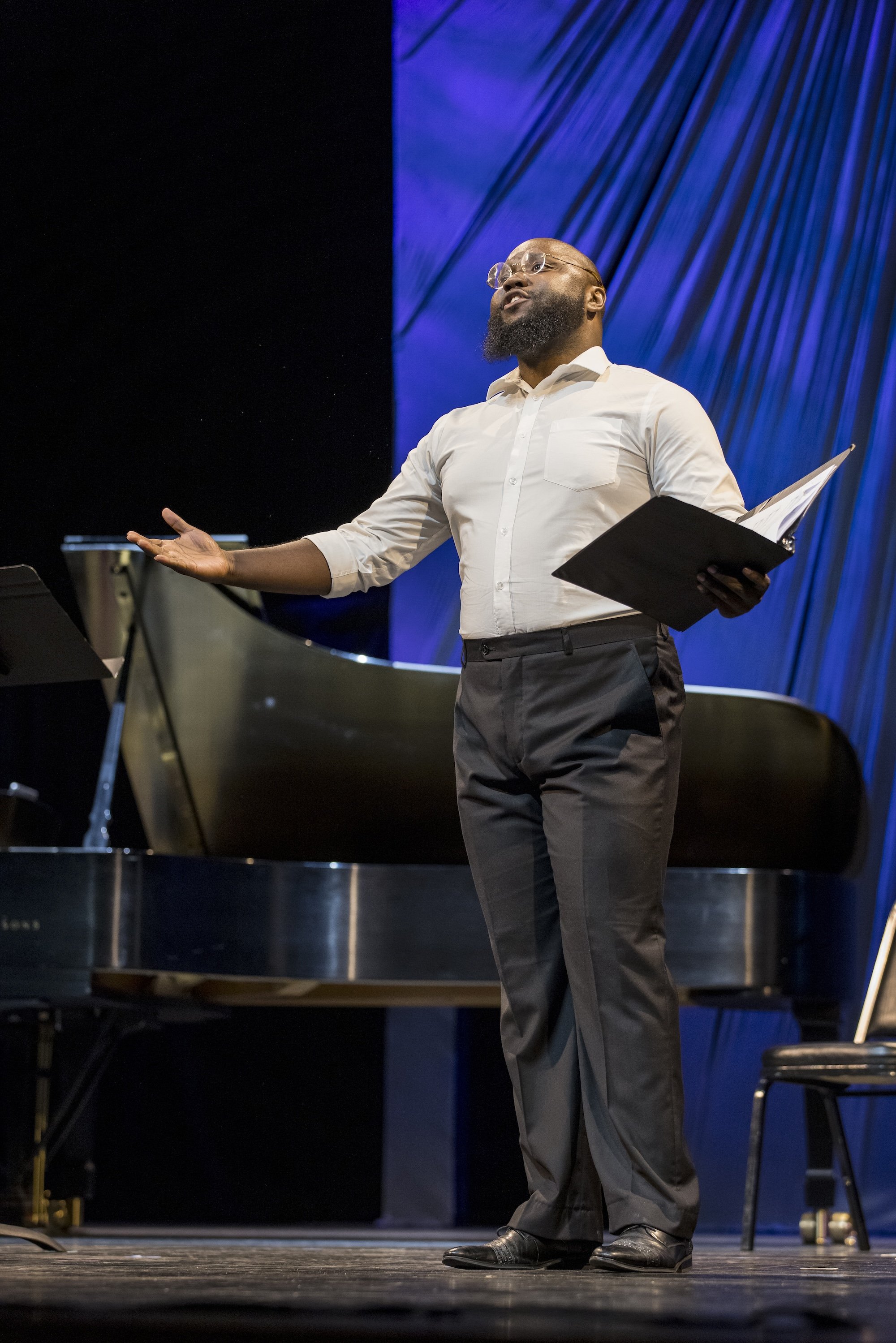


Mimeo is a short opera written for the Atlanta Opera as part of the 96-hour Opera Festival. The libretto is by playwright David Davila.
The Atlanta Opera presented the world premiere of Mimeo at the Ray Charles Performing Arts Center at Morehouse College on Monday, June 17, 2024.

Kiyoshi Kuromiya: Critical Path (2024)
for solo clarinet in b-flat and fixed media playback or clarinet ensemble
for solo clarinet with fixed media playback or optional clarinet ensemble
Preface

Kiyoshi Kuromiya. Photo used by permission from the Equality Forum.
Kiyoshi Kuromiya: Critical Path was written for clarinetist Shawn Copeland as part of an album of new pieces celebrating the lives of LGBTQ heroes. My piece is inspired by the life and work of Japanese American AIDS activist Kiyoshi Kuromiya:
Kuromiya was based in Philadelphia, where he founded the Critical Path project, which provided critical information about AIDS to the gay community using modem-connected computers and a snail-mail newsletter.
Kuromiya collaborated with architect and futurist Buckminster Fuller and is listed as an adjuvant in Fuller’s book Critical Path — a project management concept stating that to succeed at an overall goal, we must first determine the sequence of intermediary goals that need to be achieved.
Kuromiya was a friend of Martin Luther King, Jr. He protested and marched with King and took care of King’s children during King’s funeral. One story of Kuromiya’s activism during the Civil Rights Movement stuck out to me: at a sit-in demonstration in Maryland, Kuromiya and his fellow protesters kept feeding coins into the jukebox to play Irvin Berlin’s “God Bless America” on repeat. The manager eventually unplugged the jukebox.
Kiyoshi Kuromiya: Critical Path combines three musical concepts:
The work follows the timeline of the AIDS crisis from 1981 (the CDC reports a mysterious disease that seemed to have a disproportionate effect on gay men) to 2011 (a CDC study produced the first evidence of the efficacy of antiretroviral medications such as PrEP) and the myriad acronyms that progressed through the epidemic’s history. These acronyms are translated into musical motifs by using Morse code.
The piece introduces and repeats, in counterpoint, the song “America, The Beautiful” to echo the story about Kuromiya’s sit-in (because “God Bless America” is not yet in the public domain).
Finally, the work concludes with a coda that recalls how Kuromiya disseminated critical information about AIDS throughout the community.
Special thanks to Shawn Copeland, Joshua Gardner, and Stephanie Gardner for their help with workshopping and developing the initial ideas, and, of course, Shawn Copeland for believing in the project and commissioning the work.
Team
Solo B-flat clarinet with fixed digital playback or optional clarinet ensemble
Heard
Performance and recording are pending in 2024.
Distant Ringing (2023)
for vibraphone four hands
for vibraphone four hands or two vibraphones
Preface
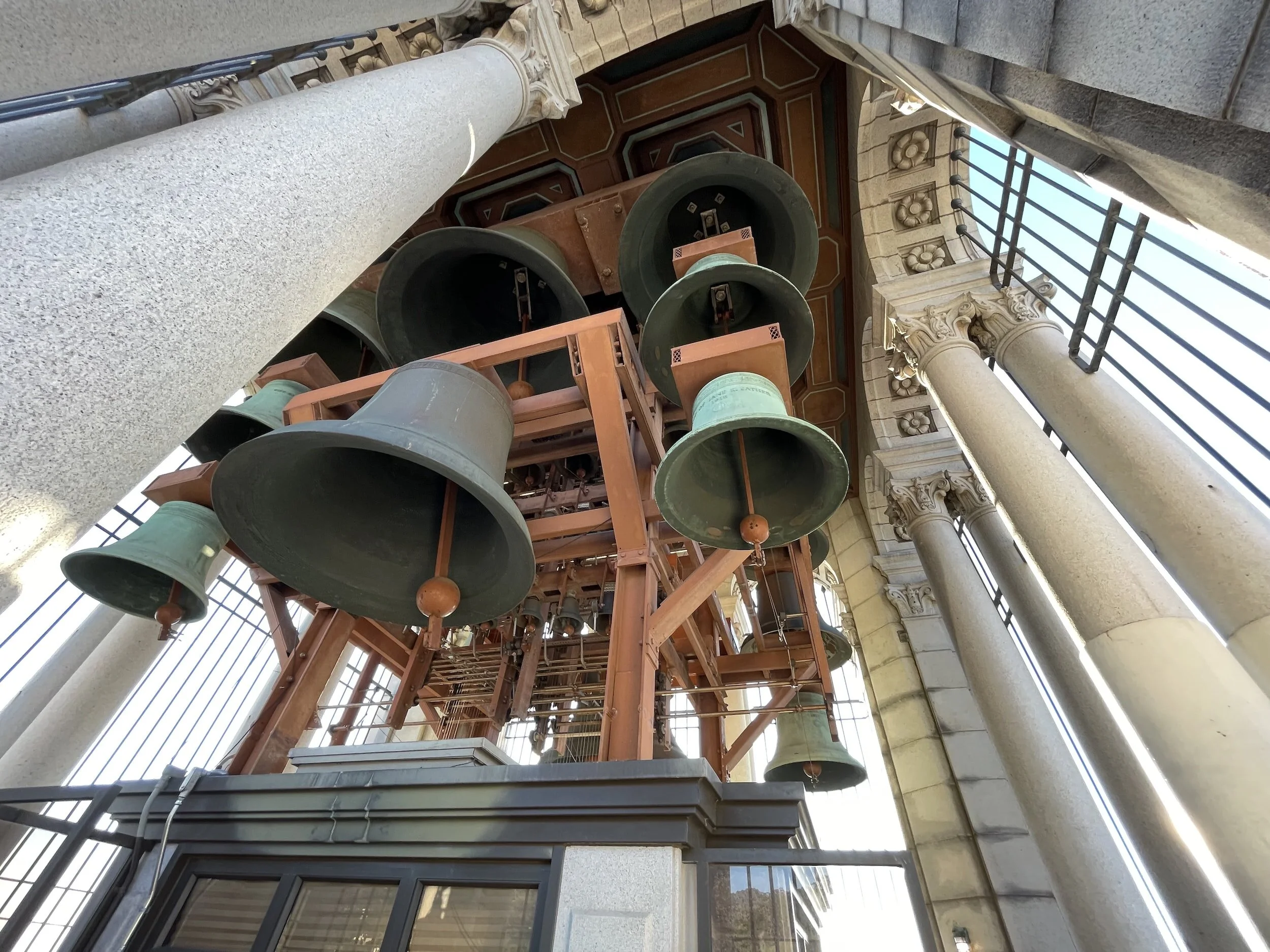
Distant Ringing is written for two players on one vibraphone. In conceptualizing the work, I wanted to find a way to highlight the pure, metallic ringing that defines the modern vibraphone, while also taking advantage of the possibilities of using multiple mallets and "dead strokes" to add color to the vibraphone's sound. I also included common permutation patterns from the English tradition of change ringing as part of the process for generating the pitch patterns. As a result, you will hear a piece where the two players continually find new ways to express a simple descending scale by gradually changing the sequence at each repetition.
Distant Ringing was commissioned Toolbox Percussion, and is written for Toolbox Percussion and the Percussion Department at the Arizona State University School of Music, Dance, and Theater.

Postcard (2022)
for mixed ensemble and digital playback
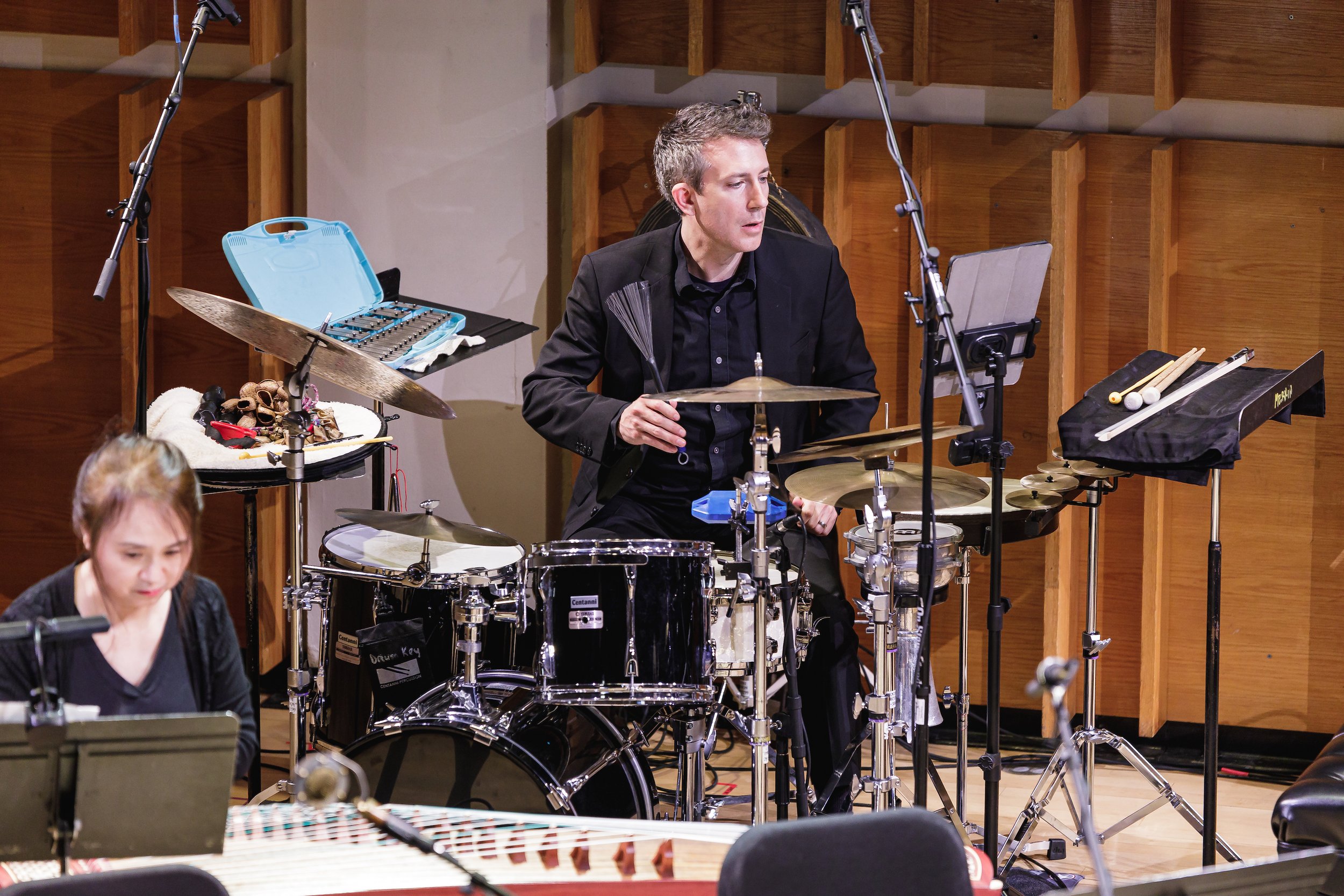
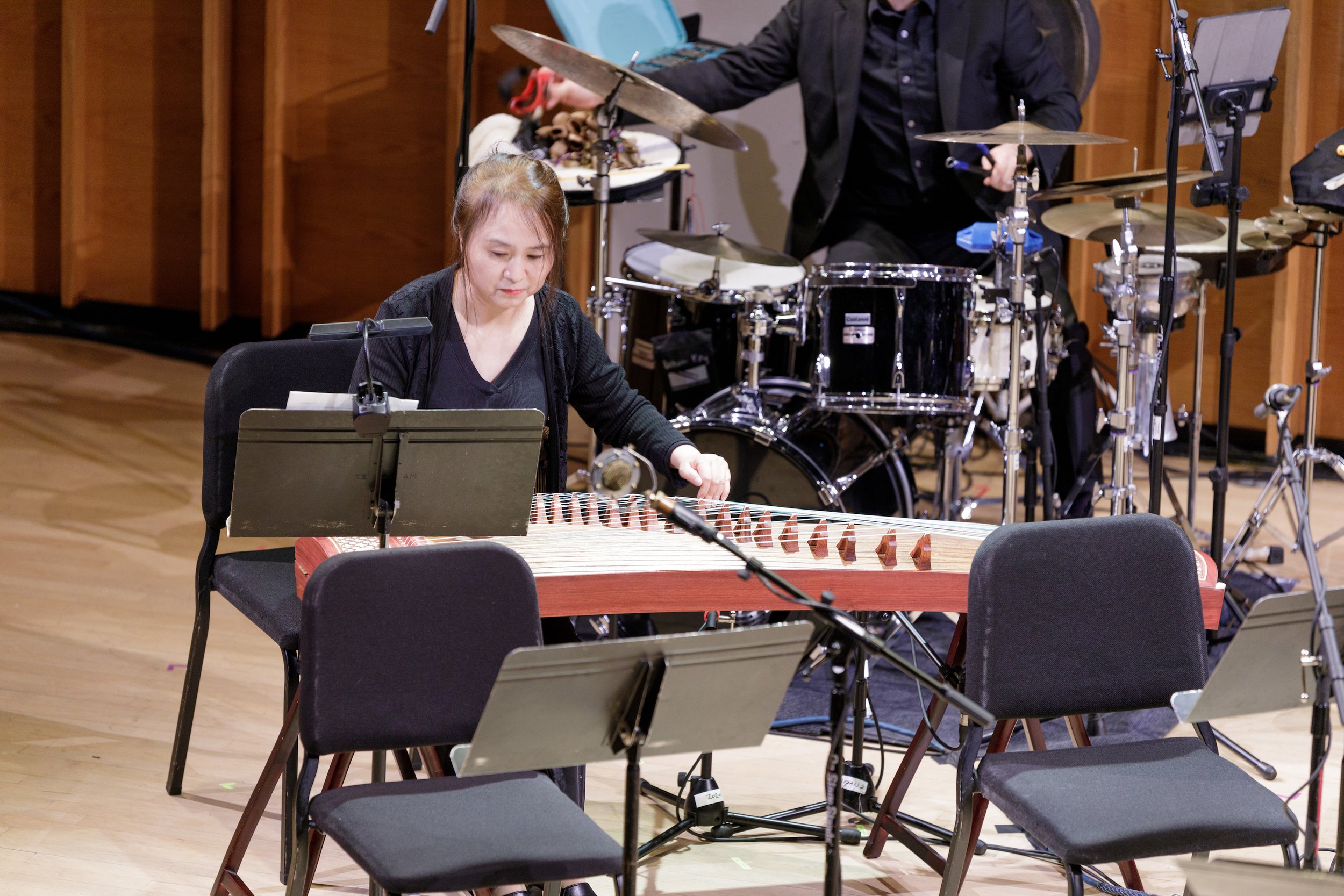
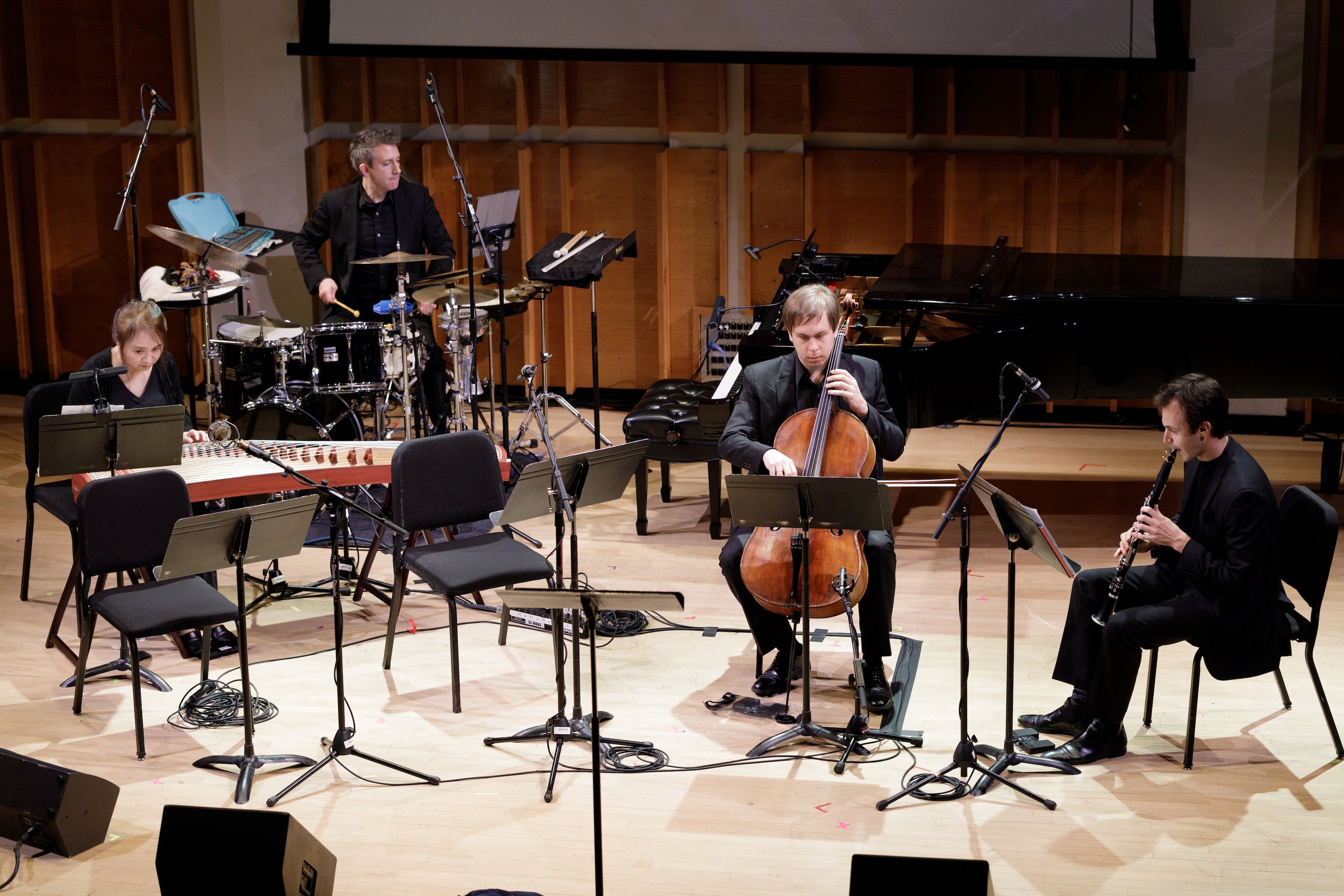
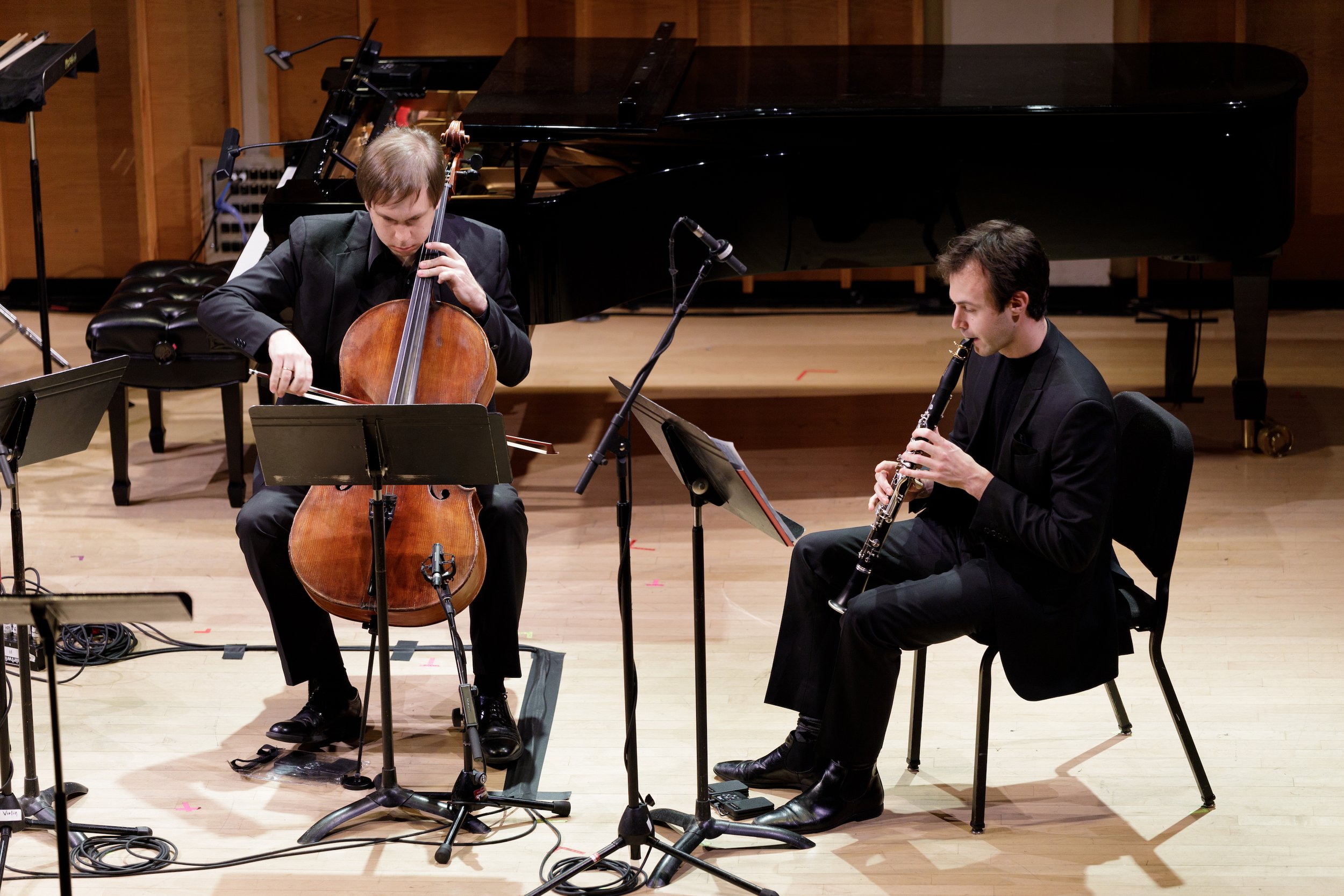
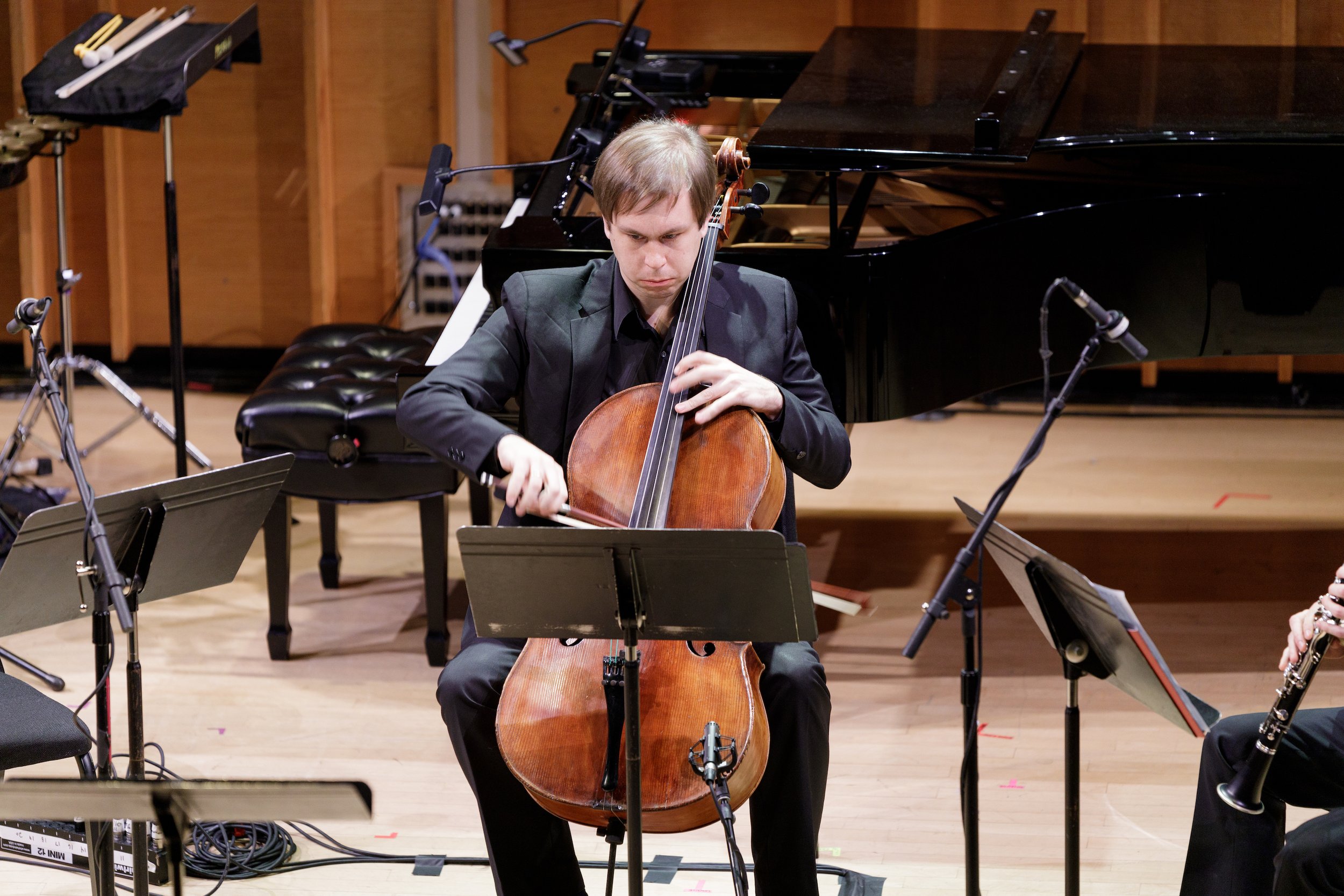
From the premiere performance at the Kaufman Music Center (New York) on December 2, 2022. Photos by Juan Carlos.

Preface
Postcard is a piece for an open-ended ensemble and digital playback. The commission was sponsored by the Hong Kong Economic and Trade Office in New York for Hong Kong Journeys, a concert on December 2, 2022, at Merkin Music Hall that celebrated the 25th anniversary of the HKSAR.
Postcard combines recorded birdsongs from Hong Kong in the fall of 2022 with musical gestures inspired by the birdsongs. While residents and visitors know Hong Kong as a modern metropolis, even among the city’s massive towers and neon lights, nature continues to thrive. Postcard invites listeners to explore this side of Hong Kong which can be so easily missed in the day-to-day, hustle-and-bustle of city life.
Heard
December 2, 2022: Kaufman Music Center (New York, NY). Yang Yi, guzheng; Graeme Steele Johnson, clarinet; Ben Larsen, cello; Alex Wyatt, percussion.

Family Association (2022)
for geolocation-enabled app, recorded oral history, and chamber ensemble
What is Family Association?
Family Association is an exploratory, immersive soundwalk for Manhattan’s Chinatown. As you walk through the streets, you will hear fragments of oral history interviews alongside music inspired by the recorded speech. At any given point during the 17-minute experience, your location in the neighborhood determines the stories and music that you hear. As a result, each soundwalk yields a unique experience.
Interviewees
Jerllin Cheng
Frank Gee
Karen Liu
Han Yu
Instrumentalists
Patrick Yim, violin
Hannah Collins, cello
Zach Herchen, saxophone
Michael Compitello, percussion
Dorothy Chan, piano
Production
George Tsz-Kwan Lam, composer
Shreyas Jadhav, software development
Taylor Snead, software development
Halsey Burgund, software development
Zach Herchen, lead audio engineer
Ian Teraoka, visual designer
Michelle Tabnick, publicist
Download The App
Experience the Family Association soundwalk with the free iOS app, now available on the App Store. It’s the preferred way for iOS users to experience Family Association along with your favorite earbuds. Even if you’re not in NYC, drag the map to explore a virtual soundwalk!
Have an Android device or using a computer? Use the Chrome browser for best results and head to https://familyassociation.app to experience Family Association! If you are located away from NYC, tap “Play” and try dragging the map to Manhattan’s Chinatown for a virtual soundwalk.
Preface
Building on my recent project (The Emigrants) with oral history and musical placemaking, Family Association is a new site-specific, geolocation-enabled piece that uses collected oral history recordings from five members of the Chinese-American community as part of an interactive soundwalk in Manhattan’s Chinatown. Listeners will hear interviewees’ memories of their extended families, how their families emigrated to the United States, and whom they imagine their ancestors to be — including those who left their homeland to seek a new future in the U.S. decades (and perhaps centuries) ago. Using GPS technology, Family Association embeds the audio within sites of various “family associations” in Chinatown; such associations have created tight-knit, supportive, social, and imagined communities based on a common family name. These associations in the neighborhood serve as a way for the listener to interact with the stories that they hear.
In Family Association, the listener will use a GPS-enabled smartphone app as they freely explore Manhattan’s Chinatown neighborhood. As the work begins, the speech is more fragmented, interspersed with musical gestures inspired by the rhythms and melodic contours of the recorded speech. When the listener approaches the site of a family association, the speech becomes more whole, recalling the way in which these micro-communities have helped generations of Chinese-Americans to both reconstruct and reconnect with their past. Over the course of the 15-minute experience, the recorded testimony gradually focuses on the interviewees’ vision of their legacy for the next generation.
Family Association is co-presented by The Performance Project at University Settlement and MATA Presents, and is made possible with support from Music At The Anthology, Inc. (MATA), and from a Faculty Impact Fund grant from the Faculty of Arts, Hong Kong Baptist University. Family Association’s app is developed with the open-source Roundware framework.
The open-source codebase for Family Association’s apps is available via GitHub. The codebase is based on the similarly open-source Roundware platform, which is also available on GitHub.
Sonnet 60 (2020)
For Soprano and Web Browser
Written for Bonnie Lander and Rhymes With Opera
Sonnet 60 was written for Rhymes With Opera’s “1-minute Operas” project, which premiered in August 2020 in a Facebook streaming event. While audiences experienced the prerecorded piece, once the music began, they are invited to open another tab in their web browser to listen to the audio of a slightly different recording of the same work, creating a canon between the two recordings. The work highlights the passage of time with both Shakespeare’s sonnet and by recreating the slight latency that we experience in live internet events.
Here’s what the score looks like:



Water In Love (2020)
for mixed voices, a capella
In Water In Love, the chorus recites Ed Bok Lee’s beautiful poem by rendering the words in a collective recitative — at times singing together in unison, and at other times branching off into shorter fragments. Lee’s poem describes a fantastic, idealized love from the point of view of water, connecting two elemental human needs into a meditation on the wild, liquid, and life-sustaining force of love. The chorus provides a wonderful, communal medium for Lee’s important message.
Ed Bok Lee, “Water In Love” from Mitochondrial Nights. Copyright © 2019 by Ed Bok Lee. Used by permission of Coffee House Press, coffeehousepress.org. All rights reserved worldwide.

The Emigrants (2018)
for cello, percussion, and digital playback
For Cello, Percussion, and Digital Playback
Commissioned by New Morse Code
Team
Cello, Percussion, and Digital Playback.
Preface
The United States is often called “a nation of immigrants” and rightly so; our history has been defined by people from other places who have risked much to build a new life here. Recent discussion of immigration highlights the experiences of foreign nationals who have decided to stay: how they can stay, if their stay is legal, and what the ramifications of their stay are. Less common, however, is the discussion of immigrants’ departure from the home they left behind; few, in other words, speak of immigrants as emigrants.
The Emigrants is a documentary chamber music work for cello, percussion and digital playback. The project began by collecting oral history interviews with the emigrant musician community of New York City’s borough of Queens, one of the most ethnically diverse urban areas in the world. The new work includes these individuals’ voices as part of the score itself, combining spoken word with instrumental music. The goal is to create a work that, through a documentary process, invites a dialogue between the audience, the musicians (both live and recorded), and the stories.
I teach at York College, The City University of New York, where our student body includes emigrants from numerous countries and cultures. I am an emigrant myself, having left Hong Kong and moved to Boston in 1992 when I was 11 years old. As a new student at an American middle school, classical music became a lifeline that bridged the gap between my experiences in Hong Kong and the United states. I started studying the violin in Hong Kong when I was six, and when I started sixth grade upon my arrival in Boston, I immediately joined the school band. Classical music became my shelter from the foreign, and music eventually became my profession in my new homeland. Through The Emigrants, I look to document similar stories from other individuals through a work of documentary music.
Heard
December 8, 2018: World Premiere at the Queens Museum (Flushing Meadows Corona Park, New York City)
June 8, 2019: Re:Sound Festival, Cleveland, New York
March 14, 2020: Blue Sage Center For The Arts, Paonia, Colorado
June 22, 2020: New Music Gathering Reimagined
August 25, 2020: Five Boroughs Music Festival “Home Brew” Livestream
March 8, 2021: Hot Air Music Festival (online performance), San Francisco Conservatory of Music
April 28, 2023: Toolbox International Creative Academy, Hong Kong
November 1, 2025: Sixth Degree Sextet, New York
Underwater Acoustics (2018)
poem by Rajiv Mohabir
for mezzo-soprano and orchestra
commissioned by American Opera Projects for the Chautauqua Opera Company
Commissioned by American Opera Projects for the Chautauqua Opera Company
Part of the Composer-in-Residence program at the 2018 Chautauqua Opera
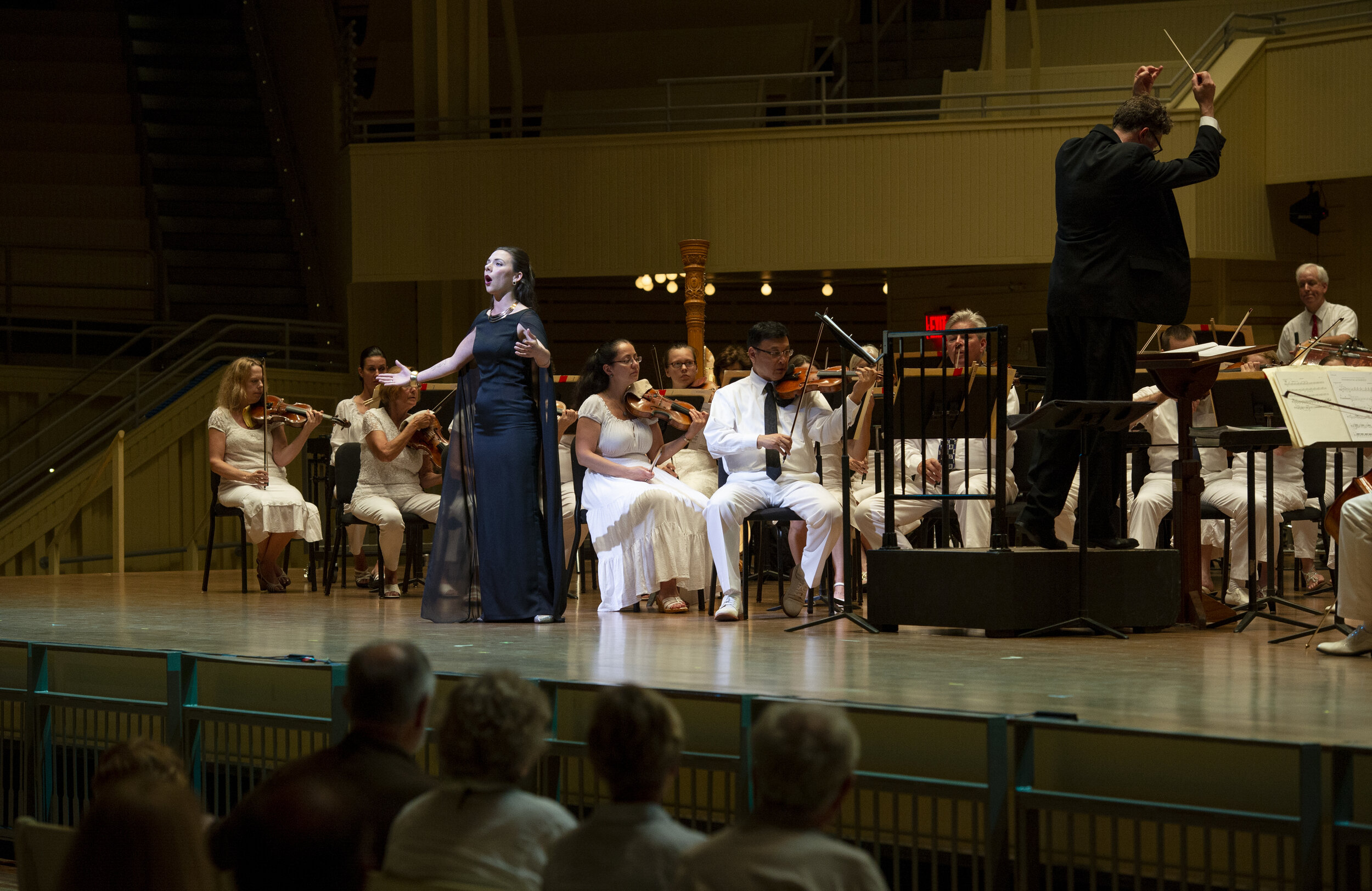
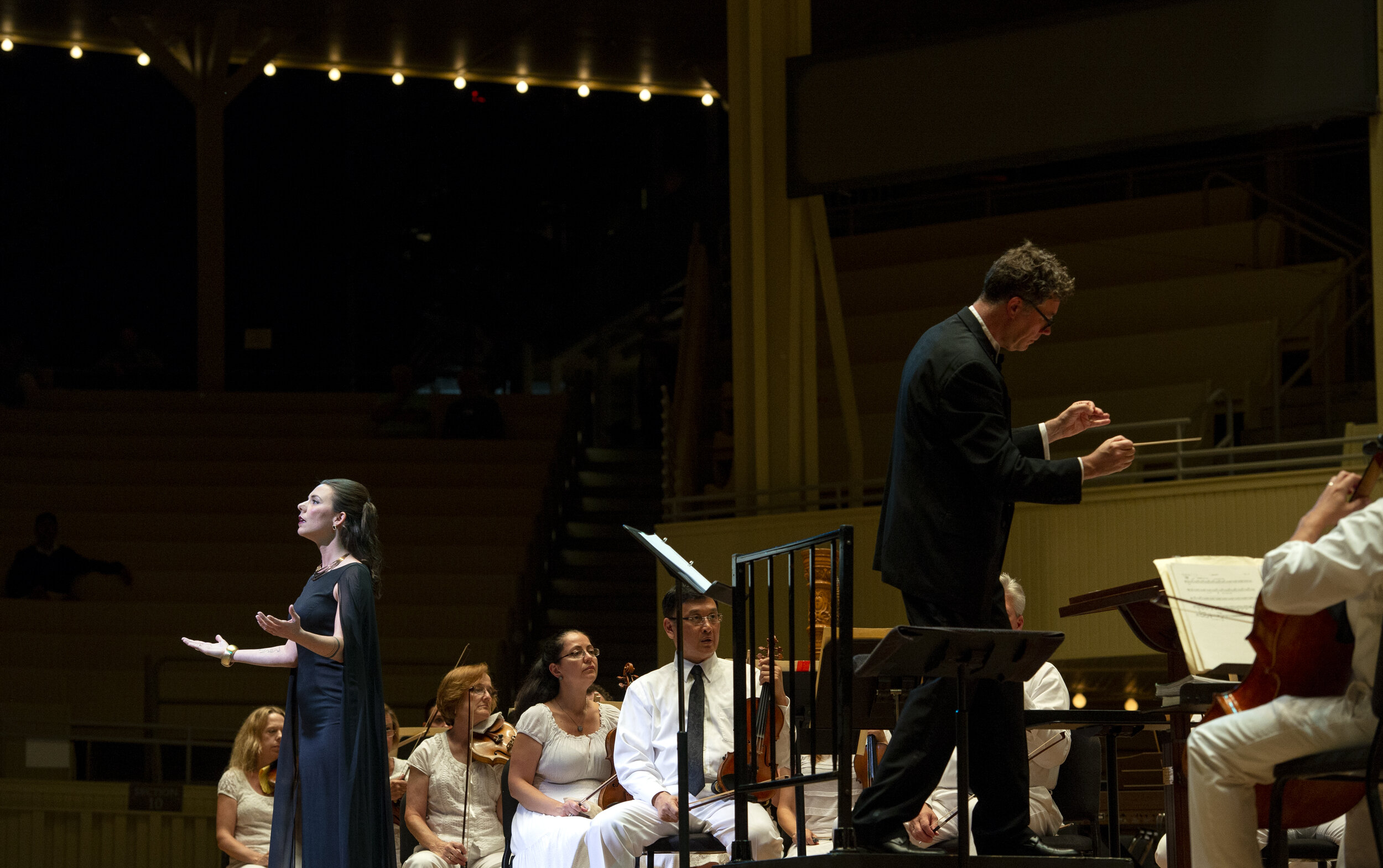
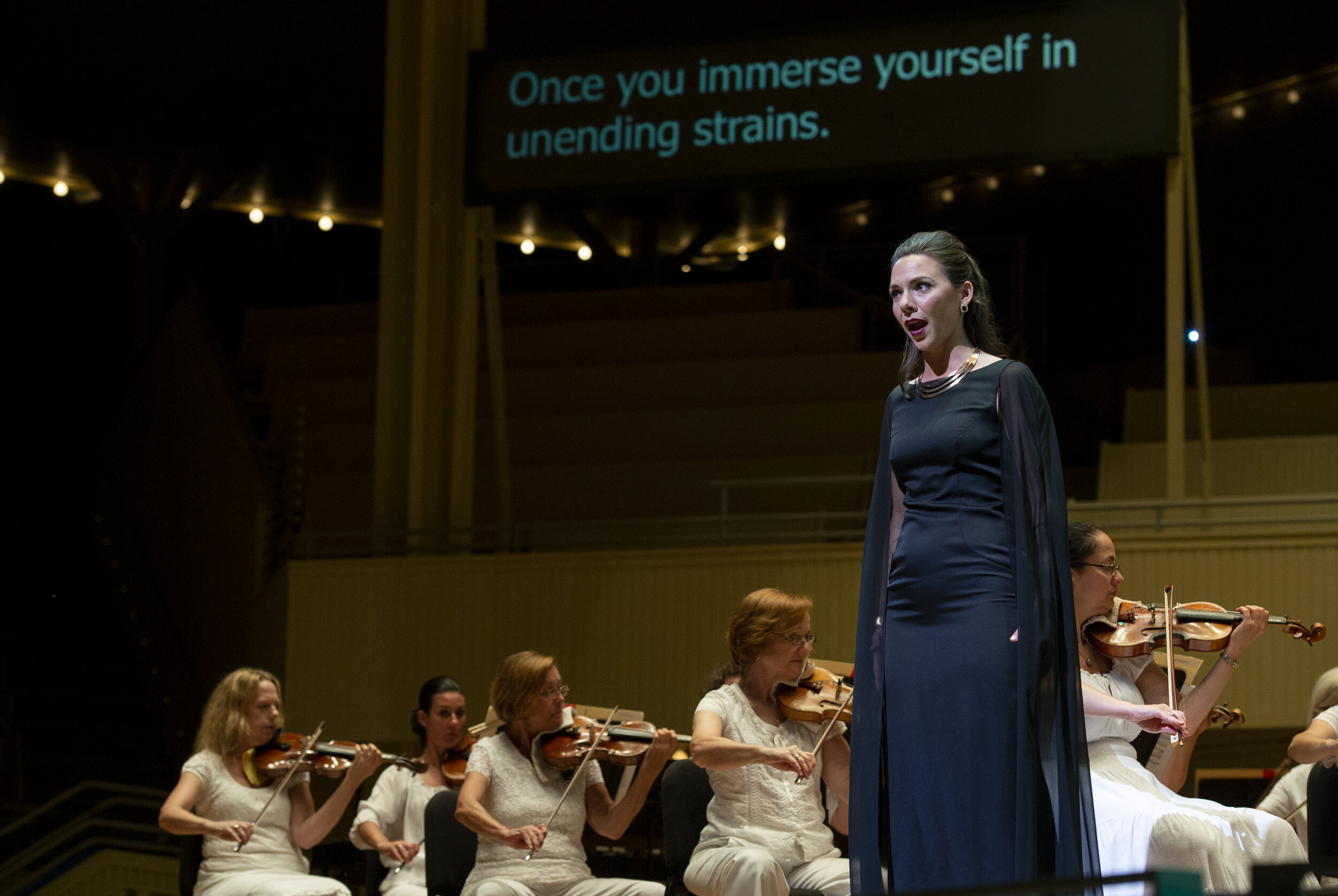
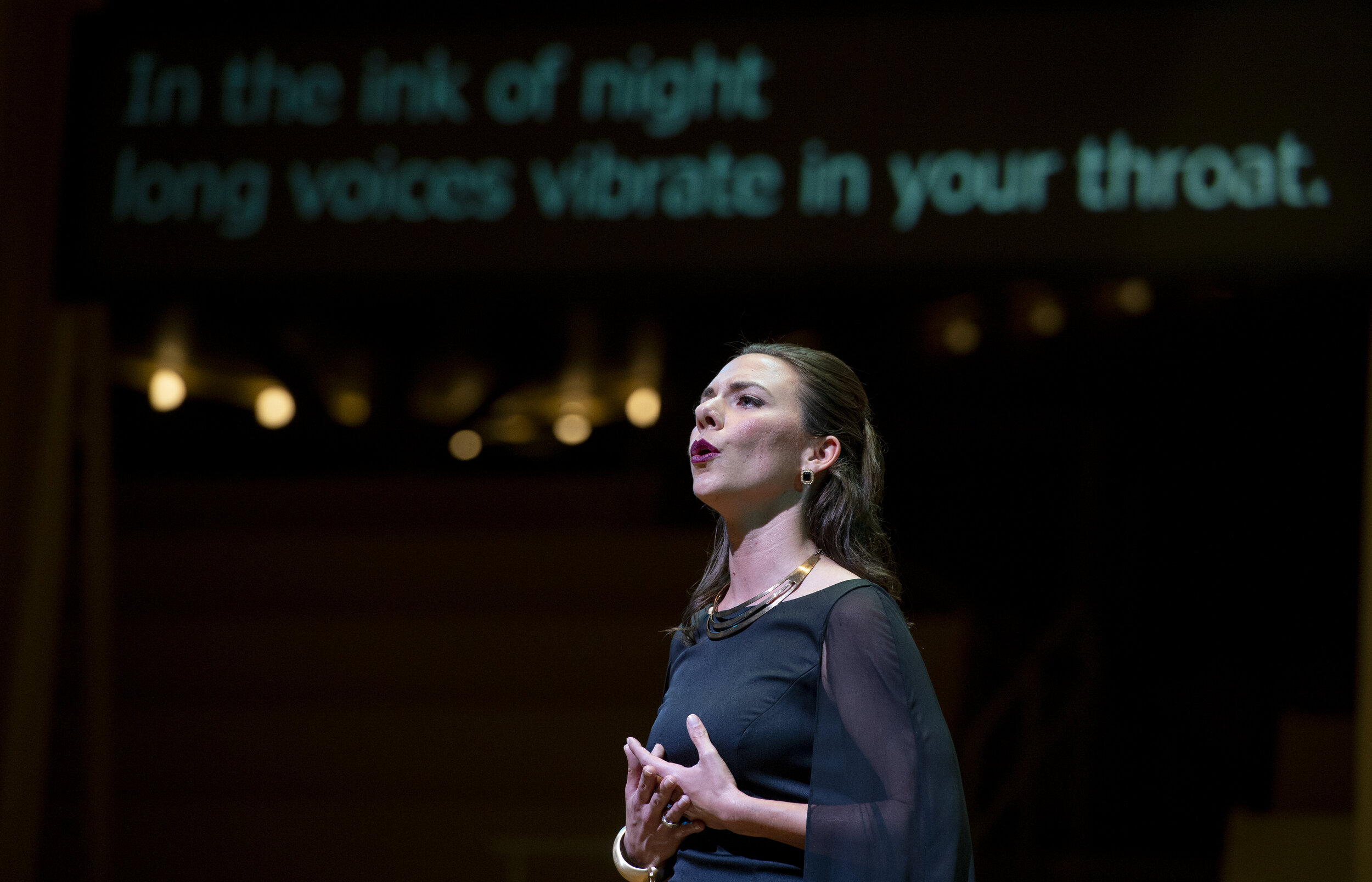
Team
2 Flutes, 2 Oboes, 2 Clarinets, 2 Bassoons, 4 Horns, 3 Trumpets, 3 Trombones, Tuba, Harp, Timpani, Percussion, Strings. Mezzo-Soprano.
Preface
Underwater Acoustics (2018) is a concert aria for mezzo-soprano and orchestra on the poem by Rajiv Mohabir. The work was composed specifically for the semi-outdoor amphitheater at the Chautauqua Institute, and incorporates a quiet hum from the audience at the piece's conclusion, inviting audiences to consider all the sounds of their surrounding environment as an integral part of the listening experience.
Underwater Acoustics was commissioned by American Opera Projects for the Chautauqua Opera Company as part of the 2018 Chautauqua Opera Composer-in-Residence program.
Heard
Underwater Acoustics received its world premiere on July 14, 2018 at the Chautauqua Institution Amphitheater, with Steven Osgood conducting the Chautauqua Symphony Orchestra, featuring mezzo-soprano Alexandra Rodrick.
Photos by Dave Munch.

Such Sweet Sorrow (2018)
poem by Allison Joseph
for bass and piano
commissioned by American Opera Projects for the Chautauqua Opera Company
Poem by Allison Joseph
Commissioned by American Opera Projects for the Chautauqua Opera Company
Part of the Composer-in-Residence program at the 2018 Chautauqua Opera
Team
Bass and Piano.
Preface
Such Sweet Sorrow (2018) is a song for soprano and piano, on a poem by Allison Joseph. This work was commissioned by American Opera Projects for the Chautauqua Opera Company as part of the 2018 Chautauqua Opera Composer-in-Residence program.
Heard
Such Sweet Sorrow received its world premiere on August 2, 2018 at the Chautauqua Institution, with Brett Bode (bass) and Miriam Charney (piano).
Photo by Sara Noble

Sissieretta Jones, Carnegie Hall, 1902: O Patria Mia (2018)
poem by Tyehimba Jess
for soprano and piano
commissioned by American Opera Projects for the Chautauqua Opera Company
Poem by Tyehimba Jess, from Olio
Commissioned by American Opera Projects for the Chautauqua Opera Company
Part of the Composer-in-Residence program at the 2018 Chautauqua Opera
Team
Soprano and Piano.
Preface
Sissieretta Jones, Carnegie Hall, 1902: O Patria Mia (2018) is a song for soprano and piano, on a poem by Tyehimba Jess. This work was commissioned by American Opera Projects for the Chautauqua Opera Company as part of the 2018 Chautauqua Opera Composer-in-Residence program.
Heard
June 28, 2018: Chautauqua Institution, with Kayla White (soprano) and Emily Jarrell-Urbanek (piano); world premiere.
February 18, 2019: Minetta Lane Theater, as part of the Olio Live Audible.com event, with Kayla White (soprano) and Jeremy Gill (piano).
March 14, 2019: National Opera Center (video above) as part of the OPERA America Emerging Artist Recitals series, with Kayla White (soprano) and Jeremy Gill (piano).
July 4, 2021: Calliope’s Call’s I, Too, Sing America concert series, as one of the winners of its 2021 Call for Scores competition; with MaKayla M. McDonald (soprano) and Julia Scott Carey (piano).
Photo by Sara Noble

Rumpelstiltskin (2018)
opera in one act
music by Ruby Fulton and George Lam
libretto by John Clum
Music by Ruby Fulton and George Lam
Libretto by John Clum
Based on the Rumpelstiltskin fable
May 11 - 19, 2018
124 Bank Street Theatre
124 Bank St, New York, NY
Overview
To celebrate their 10th Anniversary of creating and producing brand-new chamber operas, the NYC-based opera company Rhymes With Opera chose one of the oldest fairy tales in western culture. The story of Rumpelstiltskin, collected by the Brothers Grimm, dates as far back as the 17th century. A mysterious creature makes a bargain with a young woman to grant her the power to turn ordinary straw into gold. In return, Rumpelstiltskin asks for her first-born child. When she refuses, Rumpelstiltskin gives her a seemingly impossible way out: “find my name, and you may keep your child...”
In this production, themes of greed, bargaining, magic, and unconditional love combined with elaborate costumes, queer drag culture, and loud makeup transformed a very old story into a new, modern opera, inspired by the San Francisco performance troupe, The Cockettes. The fantastical title character of Rumpelstiltskin grapples between the two sides of their personality, and was portrayed simultaneously by two singers. In fact, this unique take on Rumpelstiltskin’s duality was very much reflected in the opera’s creative process: the music was a unique collaboration by Rhymes With Opera co-artistic directors Ruby Fulton and George Lam, with an original libretto by Chicago-based John Clum.
This world premiere production of Rumpelstiltskin featured Rhymes With Opera ensemble members Elisabeth Halliday (Woman/Rumpelstiltskin), Bonnie Lander (Girl/Queen), Robert Maril (Man/Rumpelstiltskin), and guest artist Timothy Stoddard (Witch/Father/King). Rumpelstiltskin’s production team included Laine Rettmer (director), Luke Miller (choreographer), Ryan Leitner (costume designer), and Conrad Chu (conductor) who led the Rhymes With Orchestra.
Production
Laine Rettmer, director
Conrad Chu, conductor
Luke Miller, choreographer
Andrea Merkx, set designer
Ryan Leitner, costume designer
Amanda Ringger, lighting designer
Kevin Connell Muth, makeup designer
Sarah Brown, stage manager
Christopher Denver and Justin Hsu, assistant stage manager and props master
Cast
Elisabeth Halliday (Woman / Rumpelstiltskin)
Bonnie Lander (Girl / Queen)
Timothy Stoddard (Witch / Father / King)
Robert Maril (Man / Rumpelstiltskin)
Rhymes With Orchestra
Jeffrey Young, violin
Nick Pauly, viola
Jennifer Girone-Virgilio, cello
Zach Herchen, saxophone
Lana Norris, piano
Maiko Hosoda, percussion

Shrewsbury Fair (2017-20)
for concert band (grade 2-3)
commissioned by Oak Middle School, Shrewsbury, MA
Team
Flute, Oboe, Bassoon, Clarinet 1, Clarinet 2, Bass Clarinet, Alto Saxophone 1, Alto Saxophone 2, Tenor Saxophone, Baritone Saxophone, Trumpet 1, Trumpet 2, Horn, Trombone, Euphonium, Tuba, Timpani, Percussion (4 players)
Preface
Shrewsbury Fair (2017) is a three-movement work inspired by locations in the town of Shrewsbury in Central Massachusetts. The work opens with Roundabout March, a short march constructed as a round that describes an imaged parade towards Artemas Ward House on Main Street. Dean Park In Autumn is a short study of the colors found in the iconic New England fall foliage. The work ends with Quinsigamond Race Day, an exciting boat race on the lake that separates Shrewsbury and Worcester.
Heard
World premiere at Oak Middle School, Shrewsbury, MA on January 26, 2018, with Anthony Uglialoro, conductor.
Shrewsbury High School Concert Band, Shrewsbury MA on April 24, 2018, with Brian Liporto, conductor.
Shrewsbury Fair was commissioned by the Shrewsbury Music / Theatre Association for the Oak Middle School Bands, Anthony Uglialoro, director. Supported in part by a grant from the Shrewsbury Cultural Council, a local agency which is supported by the Massachusetts Cultural Council, a state agency.
A Story, Again, Misremembered (2017)
for tenor trombone and bass trombone
Team
Tenor Trombone and Bass Trombone
Preface
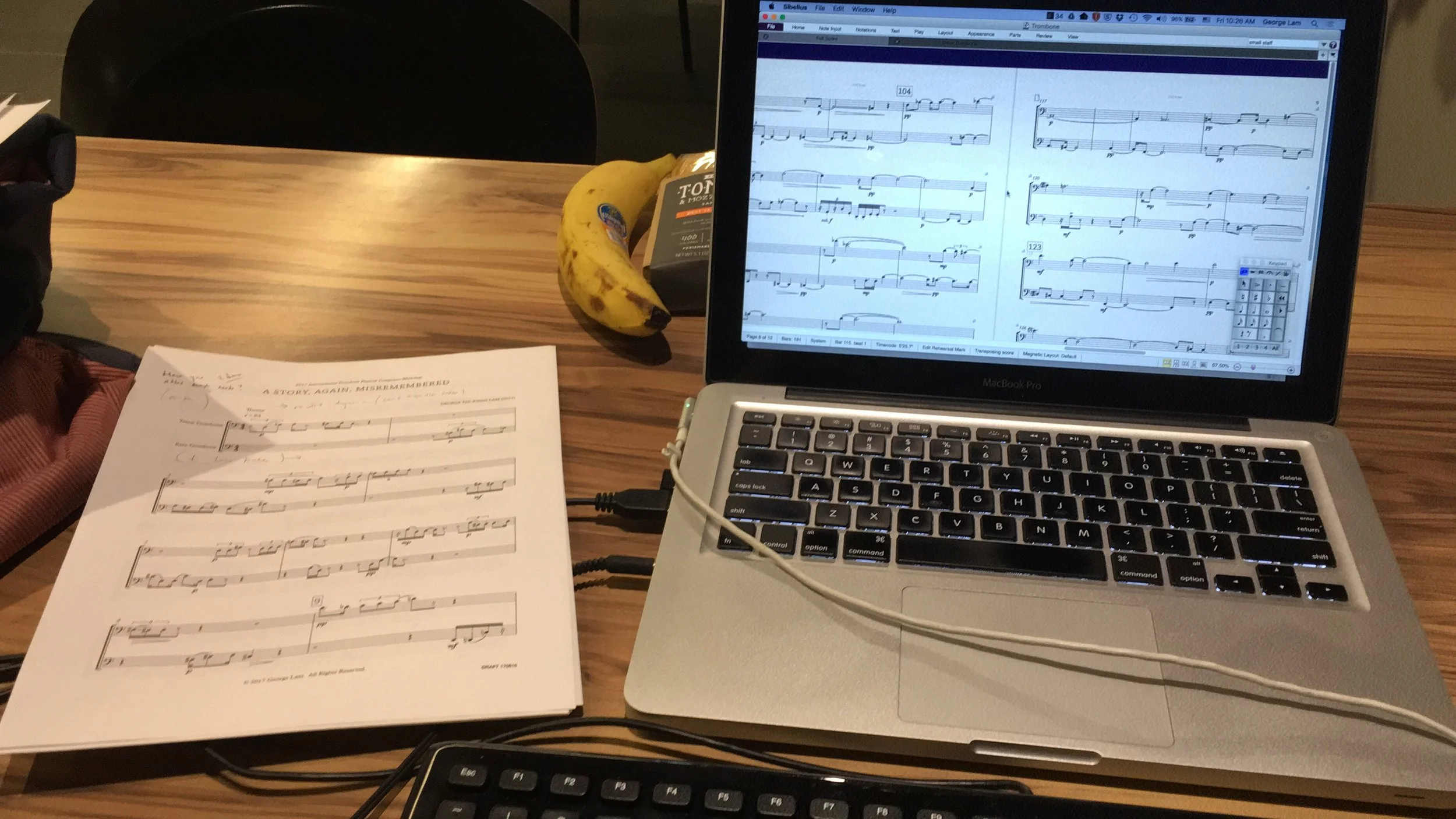
A Story, Again, Misremembered (2017) begins with a transcription of an audiobook recording: a 90-second rendition of one of Aesop’s fables. The story is first “read” from beginning to end by the two trombones (as the “theme”), and is then repeated in five variations. As the theme, the trombones closely emulate the recorded speech by using the same pitches and rhythms. In the variations that follow, the details of the original transcription gradually fade into longer and longer notes that simulate an expanding, reverberant space. As the variations progress, the listener retains key details from earlier readings of the story, but these details are also increasingly obscured. In the final variation, the listener only hears remnants of the original text as they dissolve into long arcs of sound between the two trombones.
Heard
July 1, 2017 Miguel Tantos Sevilliano (tenor trombone) and Brandt Attema (bass trombone), in a reading session as part of the 2017 International Trombone Festival, University of Redlands, Redlands, California.

Citadel (2015)
for two percussionists
written for Synergy Percussion in celebration of its 40th anniversary
Commissioned by Alden Toevs
Written for Synergy Percussion in celebration of its 40th anniversary
As part of the “40 under 40” Commissioning Project
Team
Two Percussionists
Preface
Objective: to create a game where two percussionists strategize to win. Citadel is my second game piece for percussion duet, a sequel to my 2014 work Theseus and the Minotaur. In Citadel, the two players engage in a classic game of “capture the flag”: each player moves on a game board by choosing a sequence of small percussion instruments placed on a grid, calculating the best path to steal the other player’s “flag”. The first player to return the flag to home base triumphantly sounds the gong to win the game.
Citadel was commissioned for Synergy Percussion’s 40th anniversary, as part of its 40-Under-40 Project. Synergy Percussion created a video version of the work by Nick Alexander that presents Citadel backwards (see video above). This short film begins with one of the players winning the game and ends with the dice roll.
Synergy Percussion premiered the work on December 8, 2017 in Sydney, Australia.

Heartbreak Express (2015)
opera in one act
libretto by John Clum
Chamber Opera in One Act
Libretto by John Clum
Overview
Inspired in part by Tai Uhlmann’s documentary film For The Love Of Dolly, the opera follows four Dolly Parton “superfans” waiting to meet their idol for the first time. Sisters Darlene and LuAnne entered an essay contest and won the chance to meet Dolly Parton in person. Darlene thinks that this encounter with Dolly will change their lives for the better, but LuAnne is not so sure. Longtime partners Don and Travis have amassed a huge collection of Dolly memorabilia. They poured their life savings into making a new Dolly doll, and came to get Dolly’s blessing to manufacture the new dolls. The opera follows the four fans as they meet in the waiting room and ends in a quintet (with Dolly’s mysterious Assistant) as they describe their life-changing encounters with the superstar.
This premiere production of Heartbreak Express featured the Rhymes With Opera ensemble with special guest artists, marking the culmination of RWO’s multi-year development for the work that saw excerpts presented at NYC’s Roulette, York College CUNY, the Cornelia Street Cafe, the Firehouse Space, the National Opera Center, Baltimore’s City Arts Gallery, and the historic 124 Bank Street Theater in New York’s West Village.
Reviews
Alan Sherrod, Arts Knoxville (October 22, 2022)
Steven Jude Tietjen, Opera News (February, 2016)
James Jorden, Observer (November 18, 2015)
Performances
Marble City Opera
October 20 - 22, 2022
Old City Performing Arts Center
Knoxville, Tennessee
Marya Barry, director
Logan Campbell, conductor
Whitney Wells (Luanne)
April Hill (Darlene)
Min Sang Kim (Assistant)
Ben Rorabaugh (Travis)
Daniel Spiotta (Don)
Brooke LaFontant, violin
Emily Walker, viola
Jackson Sharp, cello
Matt Rhoten, saxophone
Don Lordo, percussion
Dustin Lin, piano
Rhymes With Opera
Friday, November 13 - 21, 2015
124 Bank Street Theater
124 Bank Street, New York City
Ashley Tata, director
Conrad Chu, conductor
John Callison (Don)
Robert Maril (Travis)
Elisabeth Halliday-Quan (Luanne)
Karen Hayden (Darlene)
Peter Thoresen (Assistant)
Lisa Casal-Galietta, violin
Nicholas Pauly, viola
Jennifer Girone-Virgilio, cello
Zach Herchen, saxophone
Maiko Hosoda, percussion
Kristin Samadi, piano

Carmina Burana 布蘭詩歌 (2015, rev. 2017)
three songs for chorus
commissioned by Hong Kong Voices in celebration of its 15th anniversary
Team
Mixed Voices, A Capella
Preface
Carmina Burana was commissioned by Hong Kong Voices, an ensemble of local musicians who often highlight the rich sacred choral tradition in their performances. I wanted to respond to their repertoire by writing a work that uses a sacred Latin text (or at least one that references the church), but also write specifically for a chorus that can speak and sing in fluent Cantonese. For this work, I chose two poems from the Carmina Burana, the same set of 254 poems from an 11th- or 12th-century manuscript that Carl Orff used for his famous 1936 cantata.
The original Carmina Burana manuscript included poems that can be roughly divided into three thematic areas: songs about morals which sometimes also satirize the church, songs about love, and songs about drinking and general merriment. The three movements of my Carmina Burana similarly reflect these themes; I used a poem that warns of a corrupted clergy (Recitative: Ecce sonat in aperto) and a lively dance-song about students taking the day off to play and celebrate (Primo vere: Tempus hoc letitie). For “love”, I turned to a beautiful poem of unrequited love by Song-dynasty poet 賀鑄 (also from the 11th and 12th century).
Heard
June 20, 2015 Hong Kong Voices, China Congregational Church, Causeway Bay, Hong Kong
June 3, 2017 Hong Kong Voices, St Andrew’s Church, Kowloon, Hong Kong
Image and select photos from the June 2017 concert by Tang Ho-ching.

Ross McElwee's "Sherman's March" (2014)
chamber opera in one act
after Ross McElwee’s film “Sherman’s March”
Chamber Opera in One Act
Commissioned by the Black House Collective (Kansas City, MO)
Libretto based on a transcript from an excerpt of Ross McElwee’s film Sherman’s March, used by permission of Ross McElwee
Team
Soprano, Mezzo-Soprano, Baritone; Violin, Cello, Flute, B-flat Clarinet, Percussion (Vibraphone and Glockenspiel)
Featured performers in the recording above from the premiere:
Victoria Botero, soprano (Didi)
Josh Lawlor, baritone (Ross)
Anna Louise Hoard, mezzo-soprano (Charleen)
John James Pearse, conductor
Matthew Bennett, violin
David Boese, cello
Amy Hearting, percussion
Molly McLaughlin, flute
Sharra Wagner, clarinet
Preface
Ross McElwee originally intended his documentary film Sherman’s March to retrace General William Sherman’s famous 1864 campaign of destruction from Atlanta to Savannah. After going through a painful breakup that took place at the beginning of filming, however, McElwee shifted the film’s focus to the various women he met as he followed General Sherman’s route through the South, meditating on the futility of searching for love.
I often write operas that document life, using collected oral history and existing documentary films as inspiration. I am interested in combining the genres of opera and documentary to highlight the relationship between reality and artificiality in both. For Sherman’s March, I used an excerpt from the film and replaced the soundtrack with an operatic accompaniment, setting a simplified transcript of the dialogue to music that would be heard concurrently with the film. The excerpted scene from Sherman’s March centers on the emotional pleas by Charleen, McElwee’s friend, that he pursue a new romantic interest.
Ross McElwee’s “Sherman’s March” (1986) (my title for this piece) was commissioned by the Black House Collective for a concert of five “film operas” on the theme of love. The work was first performed at the Nelson-Atkins Museum of Art in Kansas City, MO in August 2014. Mr. McElwee was also present to film the rehearsals and performance.
Heard
August 22, 2014, The Nelson-Atkins Museum of Art, Kansas City, MO; Black House Collective

Theseus and the Minotaur (2014)
for two percussionists
written for Asian Young Musicians Connection
For two percussionists
Written for Asian Young Musicians Connection
Team
Percussion Duo
Preface
When I was approached by the Asian Young Musicians Connection to write a piece for its 2014 performance, I was inspired by composer Richard Tsang’s “Creative Musicking” approach to composition, where the performers and audience members become active participants in the musical experience. As a result, I created a board game for two percussionists where both players have to strategize in order to win the game.
Theseus and the Minotaur is based on a story from Greek mythology. King Minos of Crete trapped the Minotaur, a creature with the head of a bull and the body of a human, inside an elaborate labyrinth. Every seven years, King Minos demanded that King Aegeus of Athens send seven young men and seven young women as a feast for the Minotaur. To put an end to this sacrifice, King Aegeus’s son Theseus came to the labyrinth to kill the Minotaur. As Theseus neared the labyrinth, King Minos’s daughter Ariadne handed him a ball of string. Ariadne tied the other end of the string to the entrance so that Theseus can follow the string and find his way back out of the labyrinth after he slew the Minotaur. Theseus held on to the string as he moved around the labyrinth in complete darkness; only the sounds of footsteps from Theseus and the Minotaur can be heard.
In Theseus and the Minotaur, one percussionist plays the role of Theseus, and the other the Minotaur. The labyrinth game board consists of rooms with different textures (wood, stone, and gravel). As the players move through the labyrinth, their “footsteps” create different kinds of sounds. The players listen to the sequence of these sounds to locate and capture each other. All of the players’ moves are communicated through various percussion instruments.
Theseus and the Minotaur was composed for the Asian Young Musicians Connection, and was supported in part by a PSC-CUNY Research Fund grant from The City University of New York. Special thanks to David Jones for designing the game board, and to Sean O’Neil who helped me develop the concept for this work.
Heard
June 28, 2014: Asian Young Musicians’ Connection, Taipei National University of the Arts (Taipei, Taiwan)
String Quartet (2013)
commissioned by the Romer Quartet
Team
String Quartet
Preface
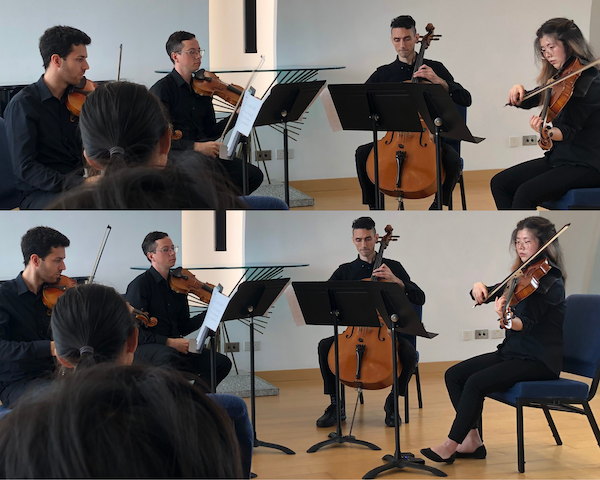
This String Quartet (2013, revised 2023) combines slowly sliding pitches and gradually shifting harmonies with the entire quartet pulsating at a constant pace. Each player subtly shifts from one static chord to another, creating a meditative and constantly evolving tapestry within the string quartet's homogenous sound world. The work was commissioned by the Romer String Quartet, who premiered the work in 2014 at the Central Conservatory of Music in Beijing, China. The work received its U.S. premiere by Ensemble Ipse in 2018 in Brooklyn, New York. The Vox String Quartet presented the Hong Kong premiere of a newly revised version of the work in 2023.
Heard
May 23, 2014: Romer String Quartet, Central Conservatory of Music (Beijing, China)
December 6, 2018: Ensemble Ipse, Areté Gallery (Brooklyn, NY)
June 24, 2023: Vox String Quartet (Hong Kong, China) – premiere of the 2023 version