
Kiyoshi Kuromiya: Critical Path (2024)
for solo clarinet in b-flat and fixed media playback or clarinet ensemble
for solo clarinet with fixed media playback or optional clarinet ensemble
Preface

Kiyoshi Kuromiya. Photo used by permission from the Equality Forum.
Kiyoshi Kuromiya: Critical Path was written for clarinetist Shawn Copeland as part of an album of new pieces celebrating the lives of LGBTQ heroes. My piece is inspired by the life and work of Japanese American AIDS activist Kiyoshi Kuromiya:
Kuromiya was based in Philadelphia, where he founded the Critical Path project, which provided critical information about AIDS to the gay community using modem-connected computers and a snail-mail newsletter.
Kuromiya collaborated with architect and futurist Buckminster Fuller and is listed as an adjuvant in Fuller’s book Critical Path — a project management concept stating that to succeed at an overall goal, we must first determine the sequence of intermediary goals that need to be achieved.
Kuromiya was a friend of Martin Luther King, Jr. He protested and marched with King and took care of King’s children during King’s funeral. One story of Kuromiya’s activism during the Civil Rights Movement stuck out to me: at a sit-in demonstration in Maryland, Kuromiya and his fellow protesters kept feeding coins into the jukebox to play Irvin Berlin’s “God Bless America” on repeat. The manager eventually unplugged the jukebox.
Kiyoshi Kuromiya: Critical Path combines three musical concepts:
The work follows the timeline of the AIDS crisis from 1981 (the CDC reports a mysterious disease that seemed to have a disproportionate effect on gay men) to 2011 (a CDC study produced the first evidence of the efficacy of antiretroviral medications such as PrEP) and the myriad acronyms that progressed through the epidemic’s history. These acronyms are translated into musical motifs by using Morse code.
The piece introduces and repeats, in counterpoint, the song “America, The Beautiful” to echo the story about Kuromiya’s sit-in (because “God Bless America” is not yet in the public domain).
Finally, the work concludes with a coda that recalls how Kuromiya disseminated critical information about AIDS throughout the community.
Special thanks to Shawn Copeland, Joshua Gardner, and Stephanie Gardner for their help with workshopping and developing the initial ideas, and, of course, Shawn Copeland for believing in the project and commissioning the work.
Team
Solo B-flat clarinet with fixed digital playback or optional clarinet ensemble
Heard
Performance and recording are pending in 2024.
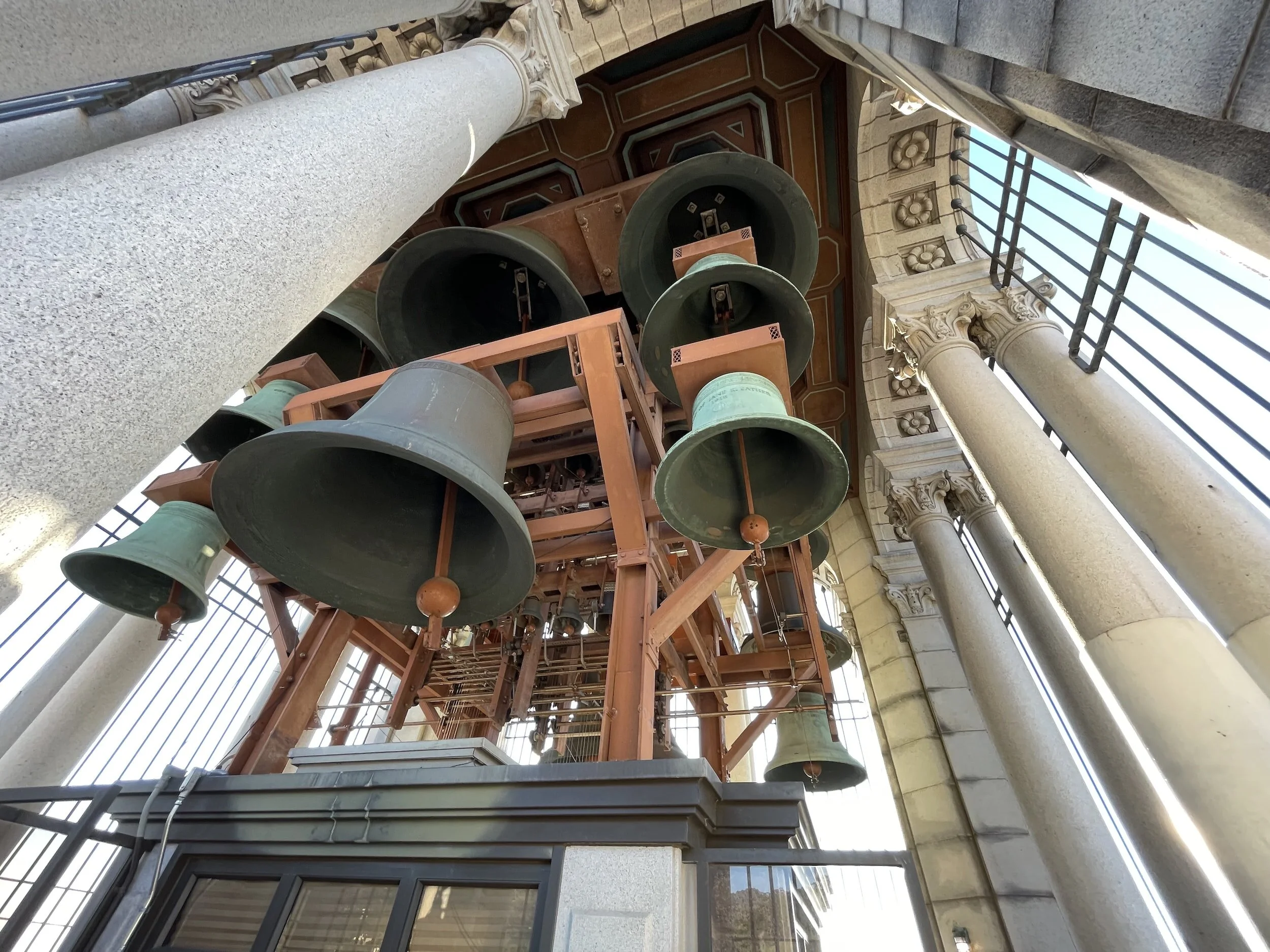
Distant Ringing (2023)
for vibraphone four hands
for vibraphone four hands or two vibraphones
Preface
Distant Ringing is written for two players on one vibraphone. In conceptualizing the work, I wanted to find a way to highlight the pure, metallic ringing that defines the modern vibraphone, while also taking advantage of the possibilities of using multiple mallets and "dead strokes" to add color to the vibraphone's sound. I also included common permutation patterns from the English tradition of change ringing as part of the process for generating the pitch patterns. As a result, you will hear a piece where the two players continually find new ways to express a simple descending scale by gradually changing the sequence at each repetition.
Distant Ringing was commissioned Toolbox Percussion, and is written for Toolbox Percussion and the Percussion Department at the Arizona State University School of Music, Dance, and Theater.

Postcard (2022)
for mixed ensemble and digital playback
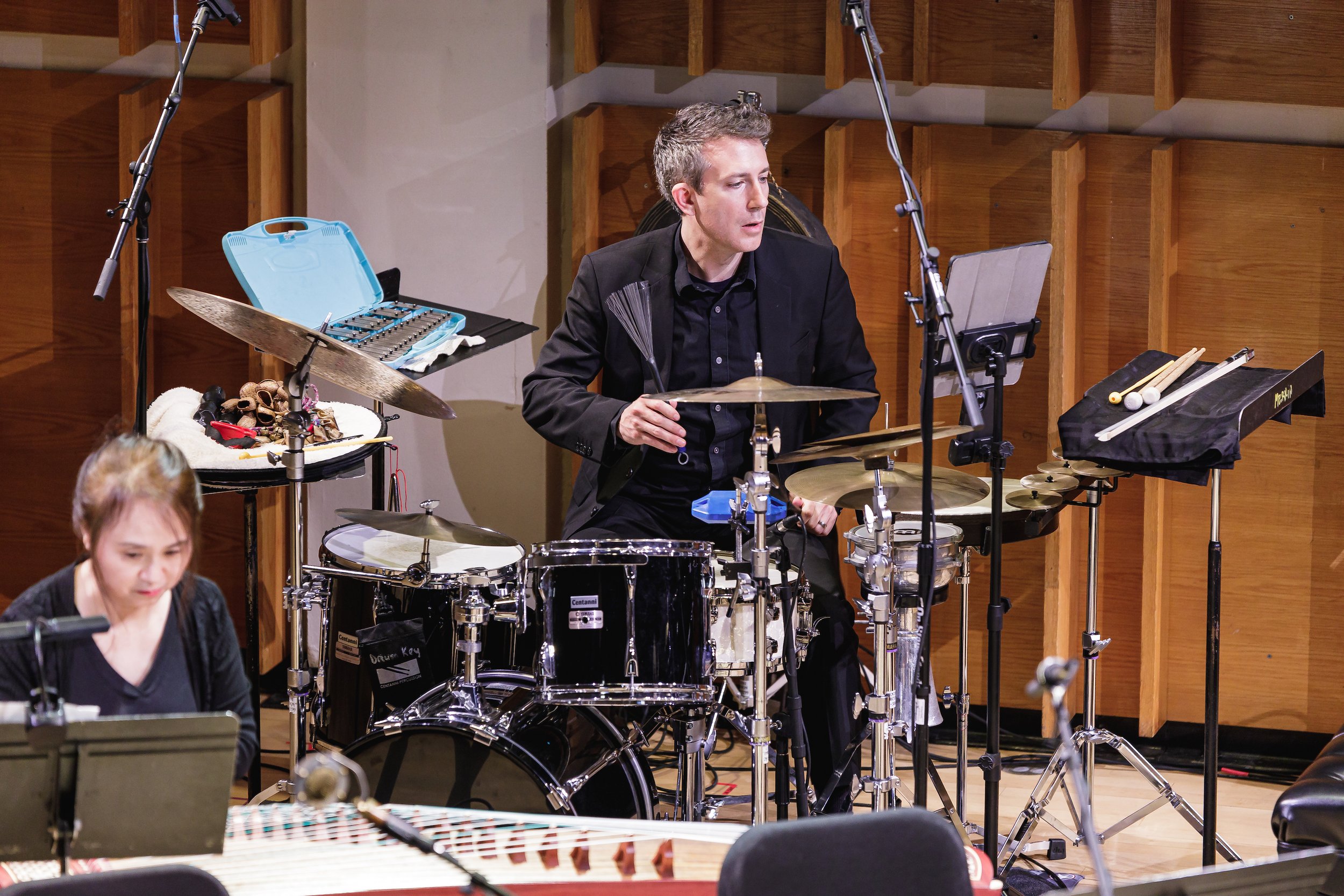
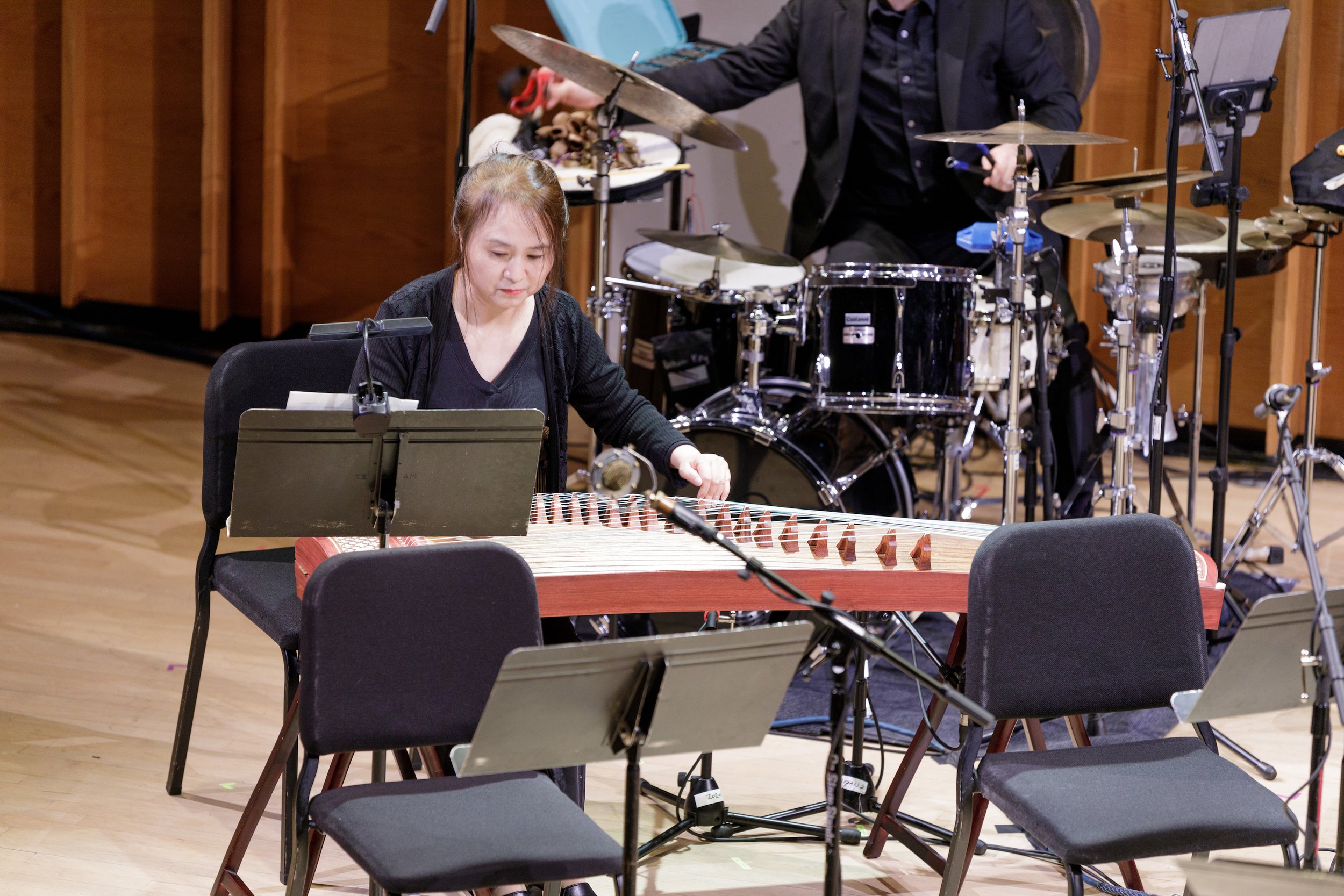
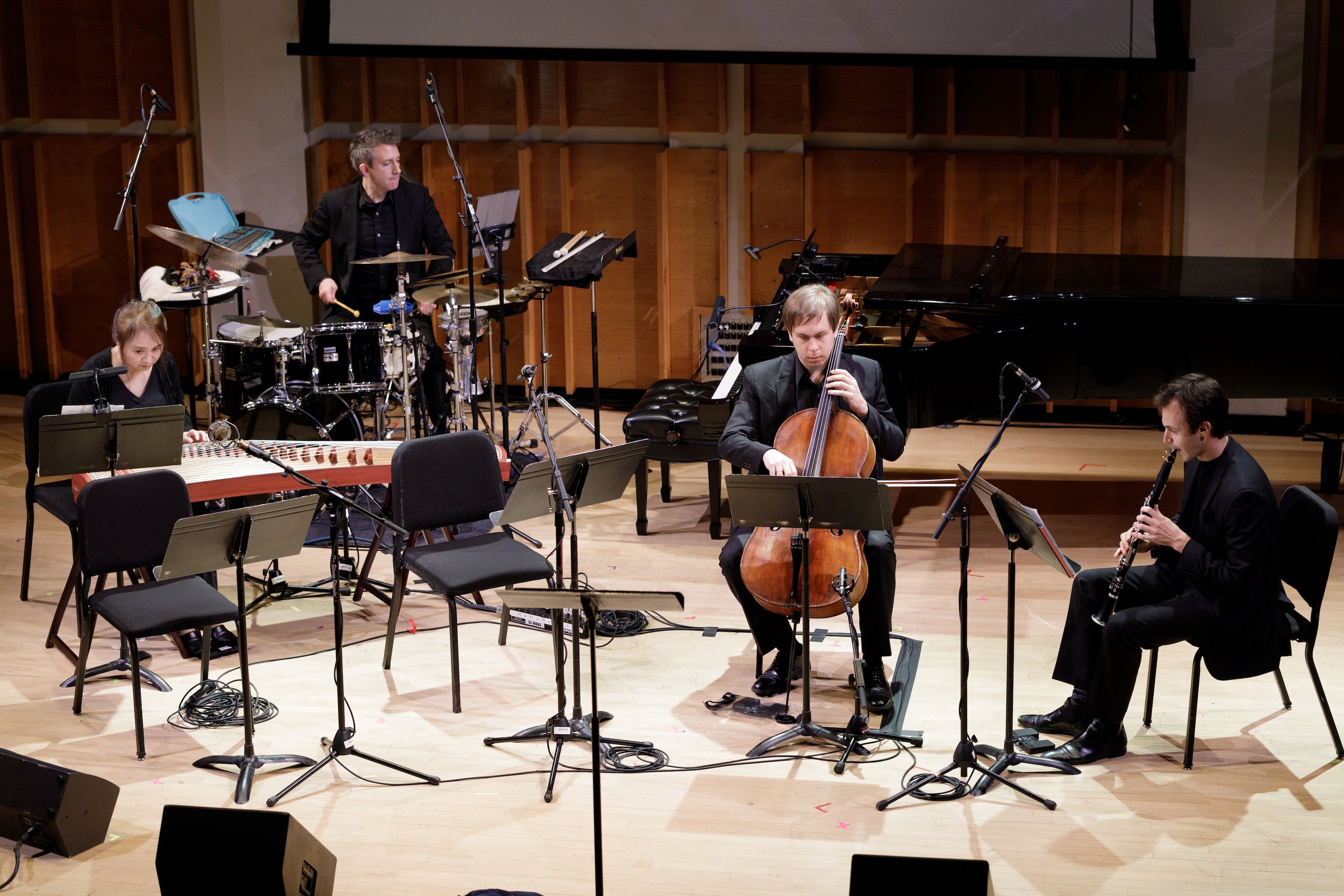
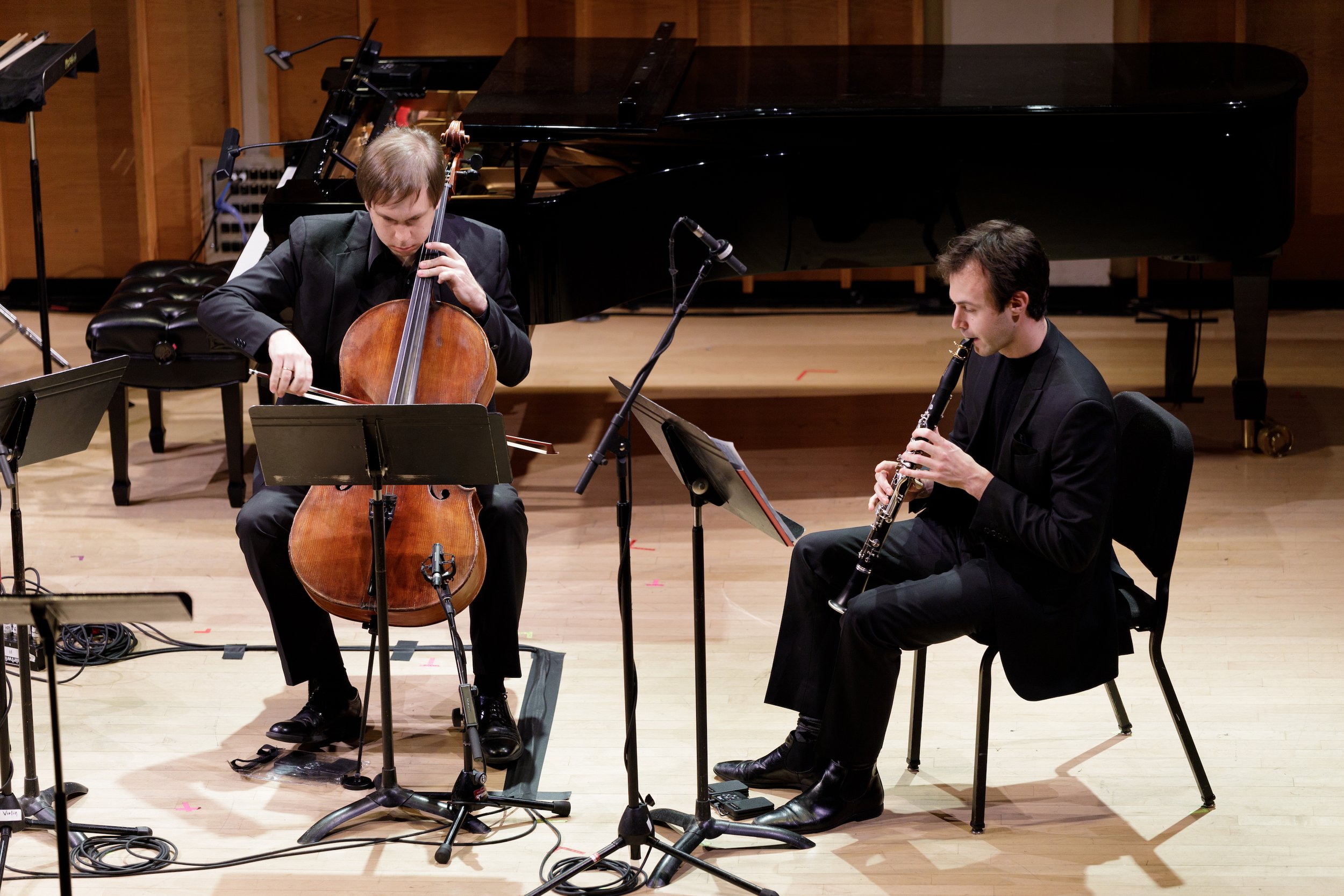
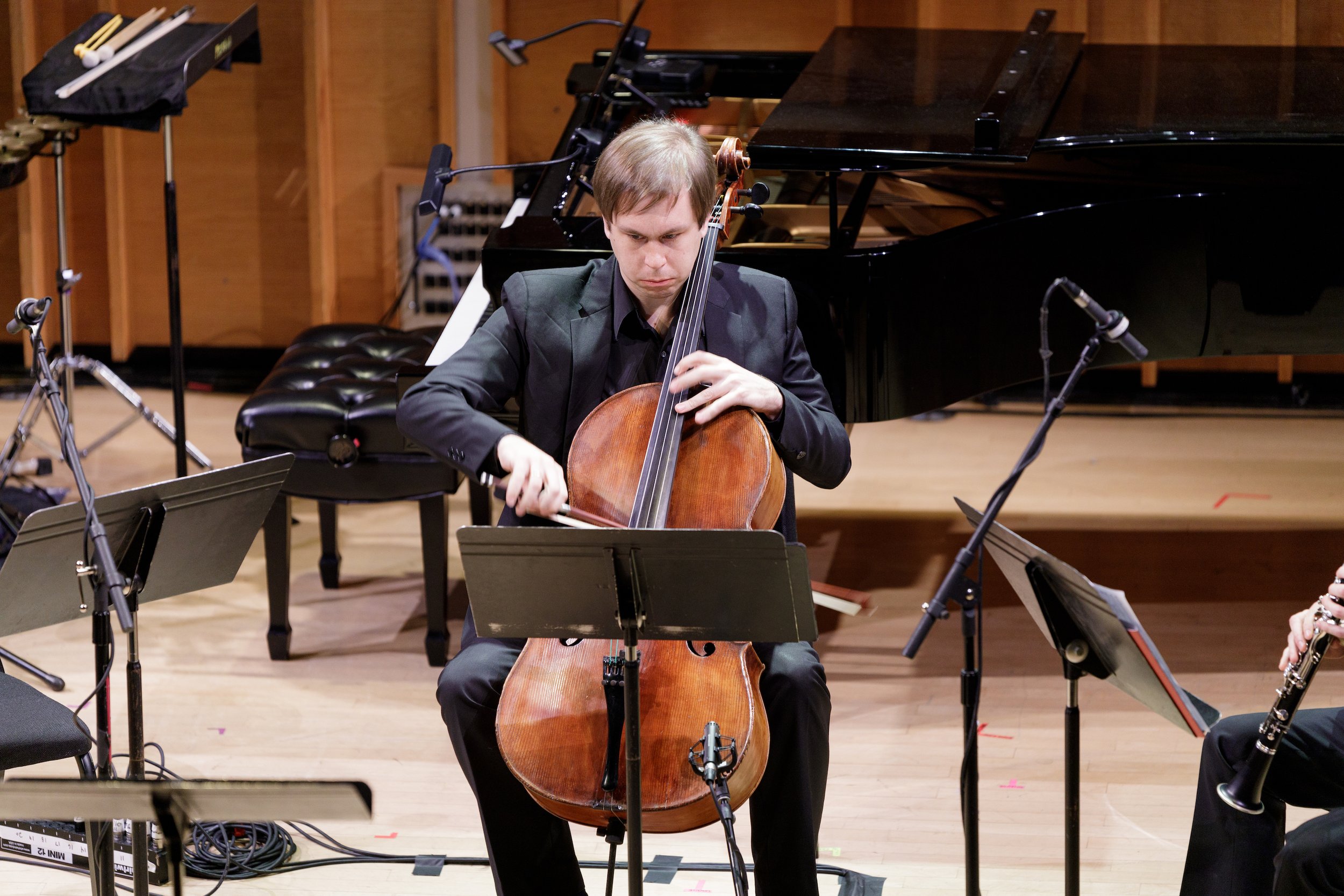
From the premiere performance at the Kaufman Music Center (New York) on December 2, 2022. Photos by Juan Carlos.

Preface
Postcard is a piece for an open-ended ensemble and digital playback. The commission was sponsored by the Hong Kong Economic and Trade Office in New York for Hong Kong Journeys, a concert on December 2, 2022, at Merkin Music Hall that celebrated the 25th anniversary of the HKSAR.
Postcard combines recorded birdsongs from Hong Kong in the fall of 2022 with musical gestures inspired by the birdsongs. While residents and visitors know Hong Kong as a modern metropolis, even among the city’s massive towers and neon lights, nature continues to thrive. Postcard invites listeners to explore this side of Hong Kong which can be so easily missed in the day-to-day, hustle-and-bustle of city life.
Heard
December 2, 2022: Kaufman Music Center (New York, NY). Yang Yi, guzheng; Graeme Steele Johnson, clarinet; Ben Larsen, cello; Alex Wyatt, percussion.

Family Association (2022)
for geolocation-enabled app, recorded oral history, and chamber ensemble
What is Family Association?
Family Association is an exploratory, immersive soundwalk for Manhattan’s Chinatown. As you walk through the streets, you will hear fragments of oral history interviews alongside music inspired by the recorded speech. At any given point during the 17-minute experience, your location in the neighborhood determines the stories and music that you hear. As a result, each soundwalk yields a unique experience.
Interviewees
Jerllin Cheng
Frank Gee
Karen Liu
Han Yu
Instrumentalists
Patrick Yim, violin
Hannah Collins, cello
Zach Herchen, saxophone
Michael Compitello, percussion
Dorothy Chan, piano
Production
George Tsz-Kwan Lam, composer
Shreyas Jadhav, software development
Taylor Snead, software development
Halsey Burgund, software development
Zach Herchen, lead audio engineer
Ian Teraoka, visual designer
Michelle Tabnick, publicist
Download The App
Experience the Family Association soundwalk with the free iOS app, now available on the App Store. It’s the preferred way for iOS users to experience Family Association along with your favorite earbuds. Even if you’re not in NYC, drag the map to explore a virtual soundwalk!
Have an Android device or using a computer? Use the Chrome browser for best results and head to https://familyassociation.app to experience Family Association! If you are located away from NYC, tap “Play” and try dragging the map to Manhattan’s Chinatown for a virtual soundwalk.
Preface
Building on my recent project (The Emigrants) with oral history and musical placemaking, Family Association is a new site-specific, geolocation-enabled piece that uses collected oral history recordings from five members of the Chinese-American community as part of an interactive soundwalk in Manhattan’s Chinatown. Listeners will hear interviewees’ memories of their extended families, how their families emigrated to the United States, and whom they imagine their ancestors to be — including those who left their homeland to seek a new future in the U.S. decades (and perhaps centuries) ago. Using GPS technology, Family Association embeds the audio within sites of various “family associations” in Chinatown; such associations have created tight-knit, supportive, social, and imagined communities based on a common family name. These associations in the neighborhood serve as a way for the listener to interact with the stories that they hear.
In Family Association, the listener will use a GPS-enabled smartphone app as they freely explore Manhattan’s Chinatown neighborhood. As the work begins, the speech is more fragmented, interspersed with musical gestures inspired by the rhythms and melodic contours of the recorded speech. When the listener approaches the site of a family association, the speech becomes more whole, recalling the way in which these micro-communities have helped generations of Chinese-Americans to both reconstruct and reconnect with their past. Over the course of the 15-minute experience, the recorded testimony gradually focuses on the interviewees’ vision of their legacy for the next generation.
Family Association is co-presented by The Performance Project at University Settlement and MATA Presents, and is made possible with support from Music At The Anthology, Inc. (MATA), and from a Faculty Impact Fund grant from the Faculty of Arts, Hong Kong Baptist University. Family Association’s app is developed with the open-source Roundware framework.
The open-source codebase for Family Association’s apps is available via GitHub. The codebase is based on the similarly open-source Roundware platform, which is also available on GitHub.

The Emigrants (2018)
for cello, percussion, and digital playback
For Cello, Percussion, and Digital Playback
Commissioned by New Morse Code
Team
Cello, Percussion, and Digital Playback.
Preface
The United States is often called “a nation of immigrants” and rightly so; our history has been defined by people from other places who have risked much to build a new life here. Recent discussion of immigration highlights the experiences of foreign nationals who have decided to stay: how they can stay, if their stay is legal, and what the ramifications of their stay are. Less common, however, is the discussion of immigrants’ departure from the home they left behind; few, in other words, speak of immigrants as emigrants.
The Emigrants is a documentary chamber music work for cello, percussion and digital playback. The project began by collecting oral history interviews with the emigrant musician community of New York City’s borough of Queens, one of the most ethnically diverse urban areas in the world. The new work includes these individuals’ voices as part of the score itself, combining spoken word with instrumental music. The goal is to create a work that, through a documentary process, invites a dialogue between the audience, the musicians (both live and recorded), and the stories.
I teach at York College, The City University of New York, where our student body includes emigrants from numerous countries and cultures. I am an emigrant myself, having left Hong Kong and moved to Boston in 1992 when I was 11 years old. As a new student at an American middle school, classical music became a lifeline that bridged the gap between my experiences in Hong Kong and the United states. I started studying the violin in Hong Kong when I was six, and when I started sixth grade upon my arrival in Boston, I immediately joined the school band. Classical music became my shelter from the foreign, and music eventually became my profession in my new homeland. Through The Emigrants, I look to document similar stories from other individuals through a work of documentary music.
Heard
December 8, 2018: World Premiere at the Queens Museum (Flushing Meadows Corona Park, New York City)
June 8, 2019: Re:Sound Festival, Cleveland, New York
March 14, 2020: Blue Sage Center For The Arts, Paonia, Colorado
June 22, 2020: New Music Gathering Reimagined
August 25, 2020: Five Boroughs Music Festival “Home Brew” Livestream
March 8, 2021: Hot Air Music Festival (online performance), San Francisco Conservatory of Music
April 28, 2023: Toolbox International Creative Academy, Hong Kong
November 1, 2025: Sixth Degree Sextet, New York
A Story, Again, Misremembered (2017)
for tenor trombone and bass trombone
Team
Tenor Trombone and Bass Trombone
Preface
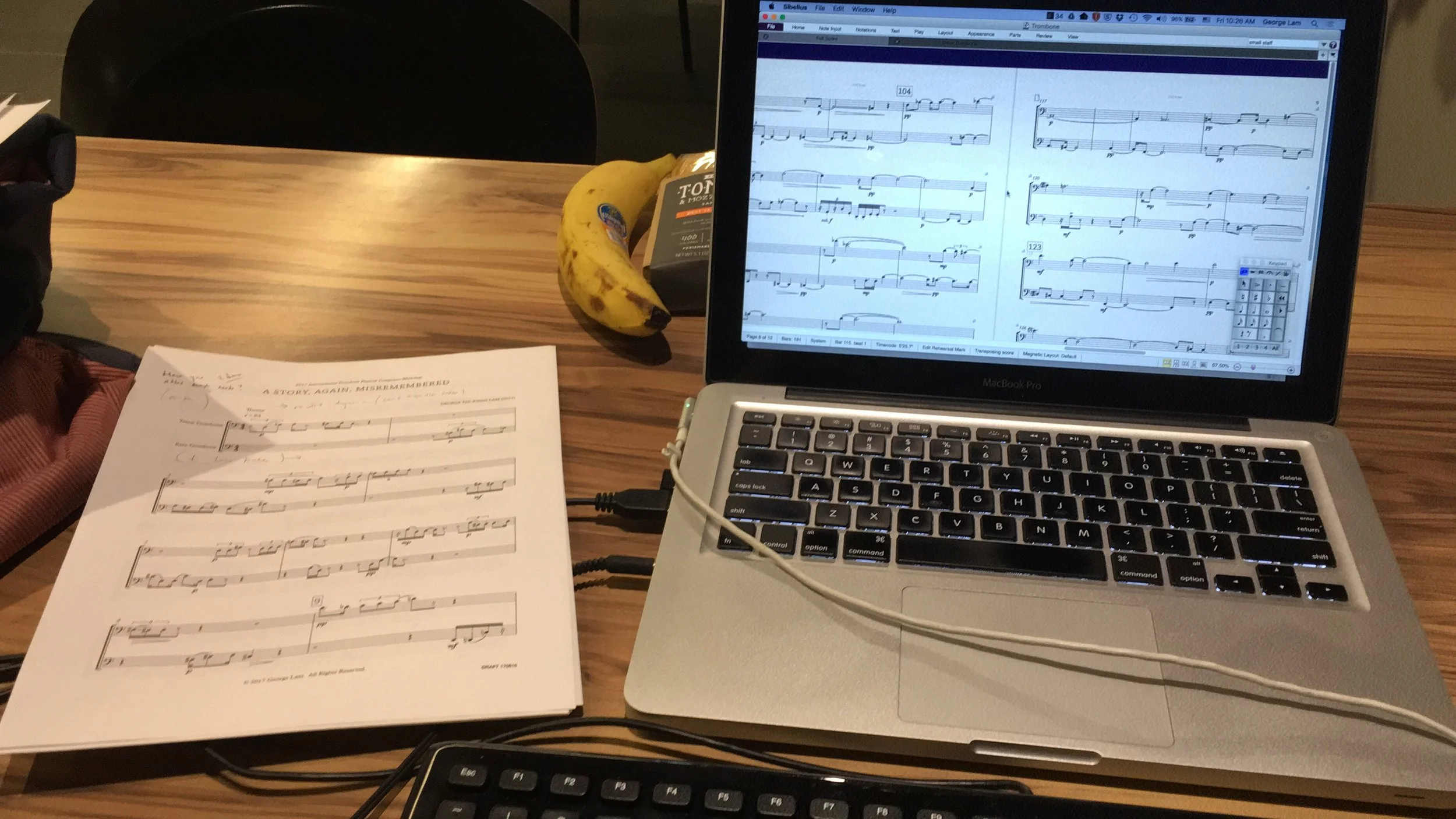
A Story, Again, Misremembered (2017) begins with a transcription of an audiobook recording: a 90-second rendition of one of Aesop’s fables. The story is first “read” from beginning to end by the two trombones (as the “theme”), and is then repeated in five variations. As the theme, the trombones closely emulate the recorded speech by using the same pitches and rhythms. In the variations that follow, the details of the original transcription gradually fade into longer and longer notes that simulate an expanding, reverberant space. As the variations progress, the listener retains key details from earlier readings of the story, but these details are also increasingly obscured. In the final variation, the listener only hears remnants of the original text as they dissolve into long arcs of sound between the two trombones.
Heard
July 1, 2017 Miguel Tantos Sevilliano (tenor trombone) and Brandt Attema (bass trombone), in a reading session as part of the 2017 International Trombone Festival, University of Redlands, Redlands, California.

Citadel (2015)
for two percussionists
written for Synergy Percussion in celebration of its 40th anniversary
Commissioned by Alden Toevs
Written for Synergy Percussion in celebration of its 40th anniversary
As part of the “40 under 40” Commissioning Project
Team
Two Percussionists
Preface
Objective: to create a game where two percussionists strategize to win. Citadel is my second game piece for percussion duet, a sequel to my 2014 work Theseus and the Minotaur. In Citadel, the two players engage in a classic game of “capture the flag”: each player moves on a game board by choosing a sequence of small percussion instruments placed on a grid, calculating the best path to steal the other player’s “flag”. The first player to return the flag to home base triumphantly sounds the gong to win the game.
Citadel was commissioned for Synergy Percussion’s 40th anniversary, as part of its 40-Under-40 Project. Synergy Percussion created a video version of the work by Nick Alexander that presents Citadel backwards (see video above). This short film begins with one of the players winning the game and ends with the dice roll.
Synergy Percussion premiered the work on December 8, 2017 in Sydney, Australia.

Theseus and the Minotaur (2014)
for two percussionists
written for Asian Young Musicians Connection
For two percussionists
Written for Asian Young Musicians Connection
Team
Percussion Duo
Preface
When I was approached by the Asian Young Musicians Connection to write a piece for its 2014 performance, I was inspired by composer Richard Tsang’s “Creative Musicking” approach to composition, where the performers and audience members become active participants in the musical experience. As a result, I created a board game for two percussionists where both players have to strategize in order to win the game.
Theseus and the Minotaur is based on a story from Greek mythology. King Minos of Crete trapped the Minotaur, a creature with the head of a bull and the body of a human, inside an elaborate labyrinth. Every seven years, King Minos demanded that King Aegeus of Athens send seven young men and seven young women as a feast for the Minotaur. To put an end to this sacrifice, King Aegeus’s son Theseus came to the labyrinth to kill the Minotaur. As Theseus neared the labyrinth, King Minos’s daughter Ariadne handed him a ball of string. Ariadne tied the other end of the string to the entrance so that Theseus can follow the string and find his way back out of the labyrinth after he slew the Minotaur. Theseus held on to the string as he moved around the labyrinth in complete darkness; only the sounds of footsteps from Theseus and the Minotaur can be heard.
In Theseus and the Minotaur, one percussionist plays the role of Theseus, and the other the Minotaur. The labyrinth game board consists of rooms with different textures (wood, stone, and gravel). As the players move through the labyrinth, their “footsteps” create different kinds of sounds. The players listen to the sequence of these sounds to locate and capture each other. All of the players’ moves are communicated through various percussion instruments.
Theseus and the Minotaur was composed for the Asian Young Musicians Connection, and was supported in part by a PSC-CUNY Research Fund grant from The City University of New York. Special thanks to David Jones for designing the game board, and to Sean O’Neil who helped me develop the concept for this work.
Heard
June 28, 2014: Asian Young Musicians’ Connection, Taipei National University of the Arts (Taipei, Taiwan)
String Quartet (2013)
commissioned by the Romer Quartet
Team
String Quartet
Preface
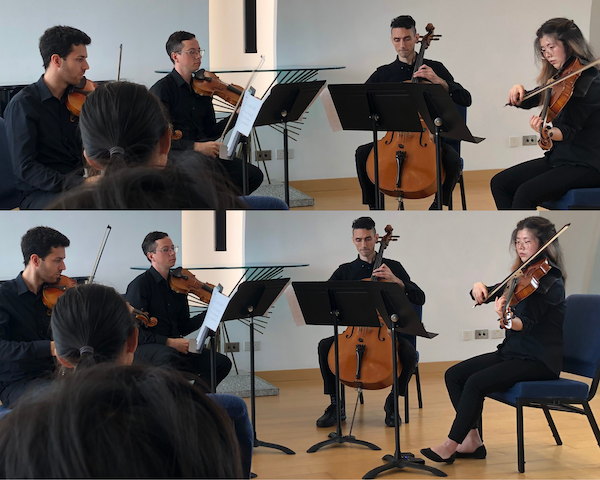
This String Quartet (2013, revised 2023) combines slowly sliding pitches and gradually shifting harmonies with the entire quartet pulsating at a constant pace. Each player subtly shifts from one static chord to another, creating a meditative and constantly evolving tapestry within the string quartet's homogenous sound world. The work was commissioned by the Romer String Quartet, who premiered the work in 2014 at the Central Conservatory of Music in Beijing, China. The work received its U.S. premiere by Ensemble Ipse in 2018 in Brooklyn, New York. The Vox String Quartet presented the Hong Kong premiere of a newly revised version of the work in 2023.
Heard
May 23, 2014: Romer String Quartet, Central Conservatory of Music (Beijing, China)
December 6, 2018: Ensemble Ipse, Areté Gallery (Brooklyn, NY)
June 24, 2023: Vox String Quartet (Hong Kong, China) – premiere of the 2023 version

Suite for Cello (2011)
commissioned by the Gesher Music Festival

Sara Sitzer, cello. World Premiere of the “Suite for Cello” at the Gesher Music Festival of Emerging Artists, June 2011.
“Whiff”, by Isodoc Dance Group, with “Suite For Cello”. In performance at the Center for Performance Research in Brooklyn, NY, 2017.
Team
Cello
Preface
Suite for Cello was commissioned by Sara Sitzer for the inaugural Gesher Music Festival of Emerging Artists, which featured music that connects classical chamber music and the Jewish perspective. As my contribution to the festival’s program, this suite is both a conversation with my favorite solo cello repertoire (including music by Bach, Britten and Ligeti) as well as a conversation with the Jewish tradition itself.
The four movements of the Suite are:
Nocturne
Elijah and the Rabbi on the World To Come
Shall the horn sound and the people not tremble
Serenade
The suite contains four movements. The Nocturne and Serenade – two “night-songs” – open and close the work, recalling the cycles of sunrise and sunset, natural events that both begin and end a day of ritual and worship. The second movement retells a story where Elijah and Rabbi Baroka of Hoza’a discuss various people destined for the World To Come, where the cello portrays the many different characters in the scene. The third movement is a set of variations on the shofar’s sound, and is based on the natural harmonic series of the cello.
Heard
June 29 and July 2, 2011, Marvin and Harlene Wool Studio Theater at the Jewish Community Center, St. Louis, Missouri.
December 13, 2017, Isodoc Dance Group performed Whiff (Jeffrey Docimo, choreographer) accompanied by the Suite for Cello.
October 29, 2022 (released on YouTube), Brian Patrick Bromberg, cello.

Possible Objects (2007)
for saxophone quartet
Team
Saxophone Quartet
Preface
Possible Objects is in two parts. Part One focuses on a single pitch, while Part Two creates a repeated, perpetually-ascending melody constructed from all twelve notes. Part One explores the slight differences in the sound of each instrument; while Part Two combines all four saxophones into a single instrument, trying constantly to reach higher and higher with each repetition of the melody.
(Taking it apart, and putting it back together.)
Possible Objects was written for the Red Clay Saxophone Quartet, and was first performed by the ensemble on March 8, 2007 at Duke University, presented as a part of the 2007 Milestones Festival of Music, sponsored by Duke University and The University of North Carolina at Chapel Hill.
Heard
March 7th-15th, 2009 AM/PM Saxophone Quartet, AM/PM and Rhymes With Opera East Coast Tour
May 11th, 2008 AM/PM Saxophone Quartet, An die Musik LIVE! (Baltimore, MD)
March 4th, 2007 Red Clay Saxophone Quartet, Duke University
This Evidence (2008)
words by Benjamin Rogers
monologue for chamber orchestra
Monologue For Chamber Orchestra
Words by Benjamin Rogers
Written for a reading and recording session with Alarm Will Sound
Team
Flute, Oboe, B-flat Clarinet, B-flat Bass Clarinet, Bassoon, Horn, B-flat Trumpet, Trombone
Violin, Viola 1*, Viola 2*, Cello*, Double Bass*
(*also speaks)
Preface
for some reason we humans keep on trying to do ourselves harm. we group together and pick fights and dominate our own humanity by regulating, dissecting, and dismembering our fellow humans. we are able to express our outrage of our handling of race or gender issues in the past and simultaneously seek out our most private parts to declare war upon.
so how does one stand up to the interrogations of the many? some protest outwardly while others simply sequester themselves behind some internal wall. either way, we humans also keep on trying to survive.
– Benjamin Rogers
Heard
February 10th, 2009 Alarm Will Sound, in residence at Duke University (recording session)

Grand Junction (2006)
fanfare for trombone quartet
Team
This work exists in two versions: one for trombone quartet, and one for brass ensemble (3 trumpets, 3 horns, 2 trombones, 1 bass trombone, 1 tuba).
Preface
Grand Junction (2006, revised 2009) was originally written as a short fanfare for trombone quartet, composed at the 2006 Aspen Music Festival for trombonists Louis Bremer, Logan Chopyk, Robert Donnelly and Geoffrey Seelen. The work was first performed on July 11th, 2006, at the Benedict Music Tent in Aspen, Colorado. The current version of Grand Junction is scored for brass ensemble.
Heard
July 11, 2006: Louis Bremer, Logan Chopyk, Robert Donnelly, Geoffrey Seelen, Benedict Music Tent, Aspen Music Festival (Aspen, Colorado)
October 1, 2009: Duke University Wind Symphony (Durham, North Carolina)

Variations On (2006)
words by Benjamin Rogers
chamber concerto for seven players
Chamber Concerto for Seven Players
Words by Benjamin Rogers
Written for the 2006 Aspen Music Festival and School and the 2006 Aspen Contemporary Ensemble
Team
Flute, B-flat Clarinet, Piano, Percussion, Violin, Viola, Cello
(*all players also speak.)
Preface
Variations On (2006) is a chamber concerto for seven players, and was written for the 2006 Aspen Music Festival and the Aspen Contemporary Ensemble. The short movement makes use of five very different strains of text, which are all spoken by the members of the ensemble. Sometimes fragments of these texts overlap. Sometimes the text is incomprehensible. Sometimes the voices are heard over the accompanying music, and at other times the music takes over and becomes the focus. The result could be described as concurrently overhearing different corners of a decidedly very different type of party.
The creative process for Variations On began with my approaching Benjamin Rogers, a writer friend of mine living in Chicago, in March of 2006. We brainstormed ideas for the piece, the texts, the music, the title. Benjamin sends me various sketches of text, and I send him piano renditions of musical fragments for each text. In the end, we decided on five different voices for the piece, and I set out to integrate all of these voices into the work. In 2007, Variations On was adapted for the Hong Kong Sinfonietta, with new Chinese translations and adaptations of the original text by Lap Lam.
Finally, what exactly happens when you hear words and music together? How does one change the meaning of the other?
Heard
October 26, 2007 Hong Kong Sinfonietta, with Yip Wing-sie, conductor.
July 13, 2006 Aspen Contemporary Ensemble, at the Aspen Music Festival and School, with Sydney Hodkinson, conductor.

Momentum Studies (2005)
two movements for three flutes
Team
Flute Trio
Preface
Momentum Studies (2005) contains two contrasting movements. Love is like a machine is rhythmic and pulsating, while Along these lines is calm and connected throughout, with only hints of intensity emerging from the even texture. The three flutes are intertwined in both movements, creating different melodies, rhythms and colors that move constantly among the three players.
Momentum Studies was commissioned by and is dedicated to the Golden Triangle Project, with special gratitude for Brook Ferguson in making this collaboration possible.
Heard
April 19th, 2006, Duke University (Durham, NC)
May 2nd, 2006 Carnegie Mellon University (Pittsburgh, PA)
October 13th, 2006 SCI Student Conference, Arizona State University (Tempe, AZ)
October 6th, 2008 New World Symphony (Miami, FL)