Listen to Chinatown
Have you heard about Chromic Duo’s Listen to Chinatown? It’s a self-guided audio tour of Chinatown hosted on the Gesso platform, and all of the profits from the tour will be donated to the Longevity Fund of Welcome to Chinatown…
It’s been almost a month since the launch of Family Association, and it has been great to gather so much feedback from listeners who tried out the app! This is such a new experience for me, and I am grateful for everyone who listened to the piece and shared their thoughts. I am working on updates to the app now, and I am excited to apply what I have learned thus far to future projects.
In the meantime, have you heard about Chromic Duo’s Listen to Chinatown? It’s a self-guided audio tour of Chinatown hosted on the Gesso platform, and all of the profits from the tour will be donated to the Longevity Fund of Welcome to Chinatown. You can read more about the piece here: https://gesso.fm/collections/listen-to-chinatown

Spring is for App Testing
Since April 1, I have been working with software developer and sound artist Halsey Burgund (and also his developer for the iOS app) to start on-site testing for the app. It’s so exciting to finally see how the original concepts are coming together, and I’m learning so much working with Halsey and his team …
Since April 1, I have been working with software developer and sound artist Halsey Burgund (and also his developer for the iOS app) to start on-site testing for the app. It’s so exciting to finally see how the original concepts are coming together, and I’m learning so much working with Halsey and his team.
Halsey is a sound artist and the founding developer of the Roundware platform – an open-source audio AR solution where users can freely explore an area to hear and record sounds. I actually had a chance to travel to Columbus, Indiana to experience one of Halsey’s Roundware projects in person. It’s a fascinating way to experience audio. When we think of augmented reality, generally it’s always about holding up a phone in front of you and seeing something added to the space. Or perhaps walking by and collecting Pokémons (I mean, I think that’s what that’s about?) The idea of Roundware combines these concepts into a purely audio experience, and I think it’s such an exciting space that’s full of artistic possibilities. A very special thanks and shout-out to Michael Reynolds at Gesso for connecting me with Halsey and Roundware. (Gesso is another audio AR guided tour app that you should check out!)
For the past month or so I have been testing prototypes of our app. Our project will focus on a native iOS app and a webapp that’s optimized to run on Chrome in Android phones. For these on-site tests, since I’m currently finishing up the semester in Hong Kong, Halsey created an alternative map for the piece where I can approximate the locations in Chinatown – but in Hong Kong. This has been such a time-saver because I don’t need to wait until I’m back in NYC to test, and hopefully we can iron out issues and troubleshoot well ahead of our launch.
After every test, I make video recordings of the user’s experience and upload them to YouTube. I send it over to Halsey, who is able to review it and then guide me to further refine the tests. I’m learning so much about the overall process of building such an app experience, and I can’t wait to get back to NYC and see how it comes together in Chinatown.

NYT: Chinatown and Family Associations
Today’s New York Times featured a story about family associations in Manhattan’s Chinatown. On one hand, the associations’ membership as well as the physical buildings that the associations call home are both rapidly aging …

A fruit stall in Chinatown.
Today’s New York Times featured a story about family associations in Manhattan’s Chinatown. On one hand, the associations’ membership as well as the physical buildings that the associations call home are both rapidly aging. A few of the buildings in particular are in urgent need of capital investments for necessary repairs. On the other hand, the associations – because of their long history in Chinatown – have amassed incredibly valuable real estate portfolios that would be in high-demand if they ever become available, leading to the possible transformation of one of the last few neighborhoods which have not yet undergone gentrification.
This is definitely a timely topic, not least because of the current cultural conversation about NYC, the Asian-American experience and our heritage as part of the city, and as we head into AAPI Heritage Month in May. It’s a fascinating article, and features a quote from Think!Chinatown’s Amy Chin, whose idea for a piece about family associations sparked my imagination for a soundwalk that highlights these fascinating organizations hidden in plain sight as you walk around the neighborhood.

What's Next
I’m working on the ending movement this week, revisiting the recordings where I asked the interviewees to reflect on future generations of Chinese-Americans. In this section, all five instruments will finally come together and play in unison rhythm with the recorded speech…
I’m working on the ending movement this week, revisiting the recordings where I asked the interviewees to reflect on future generations of Chinese-Americans. In this section, all five instruments will finally come together and play in unison rhythm with the recorded speech. The harmonies will gradually change, and will coalesce into a common chord that connects all of the interviews together.
Originally the ending was about six minutes, but because the overall scale of the piece is about 15 minutes long, I edited things a bit further to give the piece a bit more shape. No matter where you are in Chinatown towards the end of the piece, everyone will hear just this movement: either as speech, as music, or a mix of both.

Taking A Walk
This is an excerpt from a working draft of Family Association. In this work, the listener is invited to explore Manhattan's Chinatown and visit the sites of five different family associations in the neighborhood. Depending on their proximity to these locations…
This is an excerpt from a working draft of Family Association. In this work, the listener is invited to explore Manhattan's Chinatown and visit the sites of five different family associations in the neighborhood. Depending on their proximity to these locations, they will hear recorded oral history from five members of the Chinese-American community as well as music inspired by the rhythm and contour of their speech.
In this excerpt, you'll hear a marimba and a cello – creating a short duet. The cello’s music is derived from the oral history recordings that focus on the interviewees’ parents and their journey to the United States. While you are listening, imagine that you're walking closer to a family association as you hear more of their stories, and father away as you hear more music!

Workflow
I just wrapped up about two weeks of processing the oral history recordings, and this week I’m finally starting to figure out how the music will work. In particular, I want to investigate how the combination of music and speech can not only heighten and deepen our experience of the words…

A sketch of the possible areas in Chinatown that will serve as “beacons” for Family Association.
I just wrapped up about two weeks of processing the oral history recordings, and this week I’m finally starting to figure out how the music will work. In particular, I want to investigate how the combination of music and speech can not only heighten and deepen our experience of the words but also remind the listener that there is inherent musicality in all speech. By combining music and words together, where the musical material is drawn from the speech audio, I would like to guide the audience towards hearing speech as a musical (and ultimately, deeply expressive) experience.
From listening through the interviews, I organized and edited them into five themes. As a result, I also created five rough areas in Chinatown that will serve as a “beacon” for each theme.
After exploring different options, my idea at the moment is to assign a solo instrument to each area, whose music is derived from the recorded speech from that area. In the in-between spaces (i.e., Elizabeth Street), the audience will hear a combination of the music from both areas as a duet. This way, the music connects each of the areas together in a flow, and the listener is free to wander to these in-between spaces in Chinatown to hear the interaction between the different themes through music.

Working in Dorico
This is also the first time that I’m using the notation software Dorico to do the bulk of the composition and notational work. It’s definitely a learning curve at the beginning to learn software (mostly because you have to unlearn what you knew before), but I’m definitely enjoying the new workflow.
I will be working on this duets idea this week and next! Let’s see how it goes!

Musical Speech
The space between music and speech has been a common theme throughout my recent work. In the past, I listened to the recorded speech and transcribed the melodies on my own, where the unique way that I hear a certain turn of phrase translates into how I hear that speech as a musical melody…

A screenshot of how the audio software Logic hears pitch in speech.
The space between music and speech has been a common theme throughout my recent work. In the past, I listened to the recorded speech and transcribed the melodies on my own, where the unique way that I hear a certain turn of phrase translates into how I hear that speech as a musical melody. For Family Association, I’m enlisting help from software tools (Logic Pro and Dorico) to refine what the machine hears as pitch, and then translate that into music that I think would serve as an effective counterpoint to the text.
Family Association is going to be divided into a few different movements, but they aren’t really movements per se. Since the listener is free to wander Chinatown, depending on where they go, they will hear different movements. Each movement will likely center on a specific theme. This weekend I’m working on the “chinatown/memories” theme, which groups together a few common stories regarding the comfort of familiar foods.
With some experimenting, I tried to create melodies out of the speech, but also harmonies as well. Here’s what some of these experiments sound like at the moment.

Music At The Anthology
Family Association began as a project with The Performance Project at University Settlement, where I currently serve as an Artist-In-Residence for the 2021-22 season. In addition, I’m very excited for the project to be co-presented by Music At The Anthology as part of the 2021-22 MATA Presents season…
Family Association began as a project with The Performance Project at University Settlement, where I currently serve as an Artist-In-Residence for the 2021-22 season. In addition, I’m very excited for the project to be co-presented by Music At The Anthology as part of the 2021-22 MATA Presents season.
As part of this initiative, I will create in-progress project updates for MATA. In addition, I plan to lead in-person outdoor walking tours in May 2022 where participants can experience the work together. I can’t wait to share more of these updates with you as the pieces come together!


A Catalogue of Memories
We are just under two weeks away from Lunar New Year. This year, I am grateful for the technology that has enabled me to interview people across the globe and for their generosity in sharing their memories with me…
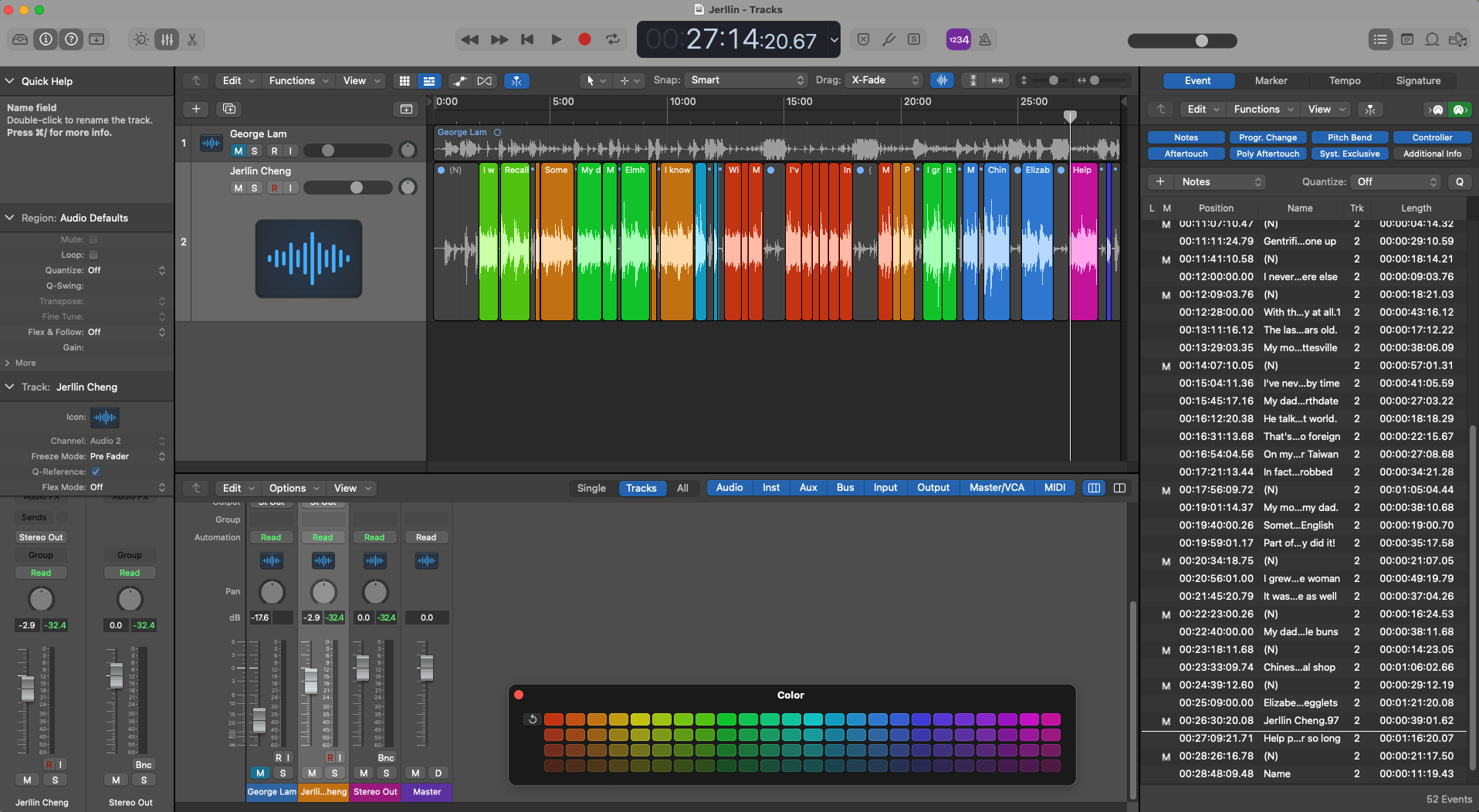
A screenshot of my conversation with Jerllin Cheng in December 2021.
We are just under two weeks away from Lunar New Year. This year, I am grateful for the technology that has enabled me to interview people across the globe and for their generosity in sharing their memories with me. As I listen and reflect on our conversations, I am also cataloging and organizing their memories for Family Association.
I have been thinking about how best to organize the themes from our conversations. The interviewees span different generations, from someone who came to the United States earlier in the 20th century to those who have since emigrated elsewhere. What ties these Chinese-American individuals together are shared memories of their families. The stories of how their parents struggled to relocate to the U.S. and raise a family represent a small fraction of thousands (millions?) of families who similarly pursued the American Dream.
I’m working on Jerllin Cheng’s interview today, which is the fourth one that I have processed so far. I decided to color-code parts of the interview according to the most salient themes that have emerged: memories of their immediate family, memories of their extended family, memories about growing up, memories of Chinatown, and the legacy they hope to offer for future Chinese-Americans. You can see a screenshot of the color-coded interview above. It’s an exciting way to visualize a 30-minute conversation that helps me see the connections even more clearly.

Hidden Associations
When I launched the project, I tried reaching out to all of the family associations in Chinatown that are organized by family name. I sent physical letters out to the associations and heard back from two individuals…
An image of the Gee Family Association building on Canal Street in New York City.
When I launched the project, I tried reaching out to all of the family associations in Chinatown that are organized by family name. I sent physical letters out to the associations and heard back from two individuals who contacted me by phone. I had the pleasure of interviewing one of them: Frank Gee, a United States veteran in his 80s, a member of the American Legion, and an integral part of his community in Chinatown — especially with his involvement with the Gee family association, located in one of the many short-and-narrow buildings that dot the landscape. The Gee's building is nestled right next to the HSBC bank by the entrance to the Manhattan Bridge. Like many of the associations in the area, it's relatively difficult to discern their locations from the street. The signage is usually on the front façade or on top of the building, which means you need to see it from the other side of the road.
Part of what fascinates me about this project is how hidden these places of connection are. Associations like the Gee's, in addition to associations related by members' ancestral homes back in China, hide in plain sight all across the country. Growing up in Boston, I remember seeing these signs in Boston's Chinatown. Even when I was growing up in Hong Kong, I remember seeing similar associations in Kowloon and wondering what they are for and who their members may be.
One of the questions that I asked Frank was how he sees Chinatown's future and the next generation. Looking at the websites of some of the more prominent family associations, it seems that these organizations are indeed trying to reach the younger Chinese-Americans and involve them in the community. Still, Frank mentioned that these organizations need to be even more progressive and forward-looking to better engage the next generation of this community-based family.
I just finished processing our hour-long (!) conversation, and am excited to share his thoughts with you in this new piece!

Working with University Settlement
In June 2021, as part of my artist residency at University Settlement’s Performance Project, I had the unique opportunity to lead workshops on collecting oral history…
In June 2021, as part of my artist residency at University Settlement’s Performance Project, I had the unique opportunity to lead workshops on collecting oral history as part of the Adult Literacy program. In preparation, I had the opportunity to sit in on two classes where I introduced myself and my project, and also to lead two “Conversation Club” sessions.

A slide from my presentation at University Settlement’s Conversation Clubs for adult English learners.
The students were enthusiastic, and all of them were eager to practice talking with each other. In my sessions, I started with the question: Will you stay in New York City for the rest of your life? And the answers that I heard were as varied as I expected, which reminded me of how much I appreciate and treasure my connection with NYC and its diverse communities – a truly unique place that can be aptly described as a melting pot.
For these sessions, I also connected the students’ interest in practicing conversational English with my work in collecting oral history recordings. I structured the session with a few interviewing tips for the students, should they be interested in collecting their own oral history recordings as well. For example, one of the tips was that a good start to an interview could include questions about the interviewee’s youth and background. Another was to avoid asking questions that could be answered with a simple “yes” or “no”. We then practiced some of these techniques in breakout rooms during our remote session, and students tried continuing their conversations with classmates (acting as “interviewees”) as long as possible.
I think oral history as a practice can not only allow us to preserve stories for the future, it can also be a great activity for students who are just starting to learn English to continue practicing their conversational skills, while also sharing their own unique stories and backgrounds on their journey to their new home.

Beginnings
The concept for Family Association has its start as a grant proposal submitted to the Alarm Will Sound Matt Marks Impact Fund. In early 2020, the Museum of Chinese in America’s archives…
The concept for Family Association has its start as a grant proposal submitted to the Alarm Will Sound Matt Marks Impact Fund. In early 2020, the Museum of Chinese in America’s archives were almost all lost to a devastating fire in a historical building on Mulberry Street in Manhattan’s Chinatown. The incident highlighted the fragile nature of the things that we hold on to – the trinkets, newspaper clippings, photos, recordings, videotapes – and the way that we all try to remember the past as we continue to construct our own identities.
As a member of the Asian-American community, but also as someone who was born in the Hong Kong and moved to the United States at a young age, I constantly found myself switching among identities: Hong Kong, Chinese, American. Growing up in Boston, I have always found Boston’s Chinatown to be both familiar and foreign: there is an ornate gate with a pagoda-styled roof that announces the entrance to the neighborhood, and yet, I don’t ordinarily see such a structure in Hong Kong. There are shops and restaurants where everyone spoke Cantonese, but it also felt foreign, especially when Chinatown ended and downtown Boston starkly began.
Now, as a New Yorker who is also currently working back in my first home of Hong Kong and looking to keep a connection with the United States through music, I am interested in the stories of today’s Chinese Americans: how do we connect with our past, how do we reconcile our connections with the two “homes” on either side of the Pacific, and how can these stories be disseminated in new ways. As a composer, I’m interested in connecting music with place, and Family Association is my way of not only continuing my relationship with New York City even from my vantage point in Hong Kong, but also creating a work that focuses on how we use our memory of the past as a way to construct communities across generations.

Hello World
This blog post is the start of my efforts to write about the creative process of Family Association. The work began life as a grant proposal submitted at the end of 2020…
This blog post is the start of my efforts to write about the creative process of Family Association. The work began life as a grant proposal submitted at the end of 2020, and is now being supported by an artist residency at University Settlement, and by Music At The Anthology, as part of their 2021 “MATA Forward” call for proposals.
Please stay tuned for more as the project continues to develop! The goal is to release the app in May 2022, in conjunction with AAPI Heritage Month in the U.S.A.
A note about the image: it’s a photo of the chinatown gate in Boston, where I lived between the ages of 12 and 21. It’s not NYC, but I would consider it my chinatown.